

Hotspot Shield VPN 2026 review: Fast Connections and Security Trade‑Offs
Invasive Data Logging: Retains session duration, bandwidth, device hashes, and anonymized domains, increasing the risk of correlation attacks.
Proprietary Black Box: The Catapult Hydra protocol is exceptionally fast but closed-source and unaudited by the public infosec community.
US Jurisdiction: Governed by Five Eyes intelligence-sharing agreements and subject to aggressive US data retention mandates.
Opaque Infrastructure: Heavy reliance on unmarked virtual servers and traditional hard drives instead of secure RAM-only infrastructure.
No Anonymous Payments: Fails to support any cryptocurrency options, forcing users to link real-world financial identities.
Compromised Free Tier: Free mobile applications embed third-party tracking SDKs to harvest and monetize user location and device data.
| 💰 Pricing | From $7.99 to $19.99/mo |
| ✅ Free Trial | 7‑day free trial on selected plans |
| 📆 Money Back Guarantee | 45 Days |
| 🗺 Jurisdiction | United States |
| 🖥 Number of Servers | 3200+ servers in 80+ countries |
| 📝 Logging Policy | No‑logs (no browsing activity logs) |
| 📥 Torrenting/P2P | Yes, supported on all servers |
| 🍿 Streaming | Unblocks major streaming platforms (Netflix, Hulu, Disney+, etc.) |
| 🛡 Kill Switch | ✅ |
| ⚙️ Protocols | Catapult Hydra, OpenVPN, IKEv2, WireGuard (select apps) |
| 🛠 Support | 24/7 Live Chat Support |
| 💻 Simultaneous Devices | Up to 10 devices on Premium |
| 🔥 Current Deal | 77% OFF |
Overview
Architectural philosophy & market positioning
When evaluating a VPN, the corporate structure behind the software matters as much as its cryptographic stack. Hotspot Shield has one of the most turbulent corporate histories in cybersecurity. Originally launched in 2008 by AnchorFree, the company restructured in 2019 into Pango. In July 2020, Pango was acquired by digital security conglomerate Aura. Then in December 2024, Pango Group merged with Total Security to form Point Wild, the current controlling entity.
This pattern of constant ownership changes is not cosmetic. It has direct, measurable consequences for privacy:
- Policy fragmentation: Every acquisition triggers a revision cycle for Terms of Service, Privacy Policy, and internal data retention schedules. These changes are rarely announced prominently. A user who agreed to one logging policy in 2022 may now be subject to a materially different one.
- Data aggregation at scale: Point Wild is not a VPN-only company. It controls brands including Betternet, VPN360, and Comparitech, serving over 25 million monthly active users and generating an estimated $600 million in annual revenue. At that scale, user metadata becomes a significant business asset, separate from any VPN subscription revenue.
- Jurisdictional lock-in: Through all of these mergers, the core operational headquarters has remained in the United States.
That last point carries real legal weight. The US is the founding node of the Five Eyes intelligence-sharing alliance and operates under surveillance frameworks that include National Security Letters, FISA court orders, and the Patriot Act. Unlike providers incorporated in Switzerland or the British Virgin Islands, Point Wild can be legally compelled to hand over user data and can be subject to gag orders that prevent disclosure to affected users. You are not choosing between two similar products; you are choosing between a privacy-oriented legal jurisdiction and one with the broadest lawful access powers in the Western world.
The mechanics of the freemium tier
Hotspot Shield’s “Basic” free plan is marketed as a risk-free introduction to the service. A closer look at its network behavior makes clear that you are not paying with money; you are paying with telemetry data.
The technical constraints of the Basic tier are deliberately severe:
- Hard throttling at 2 Mbps: This cap is enforced at the server level using traffic shaping, not congestion. At 2 Mbps, 1080p streaming fails consistently, and even a 500 MB software download takes well over 30 minutes. This is not a consequence of resource limitations. It is an engineered pressure mechanism to push users to the paid tier.
- Single US location: Users are locked to one virtual server location in the United States, with no ability to select alternate routing paths. This eliminates any practical utility for bypassing regional content restrictions or optimizing latency for non-US-based services.
- One simultaneous connection: The plan blocks multi-device use, making it unusable for anyone who wants to protect a laptop and a phone simultaneously.
The more significant cost, however, is privacy. Hotspot Shield’s free mobile applications embed third-party tracking SDKs, including code from advertising networks such as Google. An SDK is not an add-on; it is compiled directly into the app’s binary. While the VPN tunnel encrypts your traffic from your ISP at the network layer, the embedded SDK operates at the application layer, inside your device. It collects and transmits device hashes, MAC address identifiers, IMEI numbers, and coarse geolocation data derived from your current IP address to third-party data brokers.
The result is a technically coherent contradiction: your ISP cannot see your traffic, but advertising networks can fingerprint your device and approximate your location. For a threat model focused on corporate surveillance, the free tier of Hotspot Shield actively worsens your position compared to using no VPN at all.
Pricing & Plans
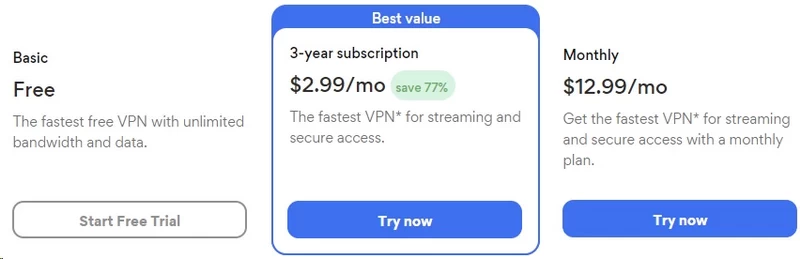
Pricing matrix & the “bundle” confusion
For a service that omits RAM-only server infrastructure, open-source protocol support, and independently audited source code, Hotspot Shield carries an above-market price. Below is the current pricing structure for their Premium tier:
| Plan Duration | Monthly Cost | Total Billed | Notes |
|---|---|---|---|
| 1-Month Plan | $12.99 | $12.99 | Expensive for short-term use. |
| 1-Year Plan | $7.99 | $95.88 | Significantly above the cost of faster competitors. |
| 3-Year Plan | $2.99 | $107.64 | Best per-month rate, but demands a 36-month commitment. |
Note: Pricing reflects regional variations and is subject to promotional changes without advance notice.
At $7.99 per month on the annual plan, Hotspot Shield is priced above competitors like Surfshark (roughly 1.99/month at the time of writing) and NordVPN, both of which outperform it on protocol transparency, audit frequency, and benchmark speeds.
Historically, Pango and Aura tried to justify this premium by bundling Hotspot Shield with secondary tools: 1Password for password management, Robo Shield for spam call filtering, and Identity Guard for identity theft monitoring. In practice, this bundle has fractured. Depending on which geographic region you are in and which landing page you access, these additions are either omitted entirely, listed as separate up-sells, or replaced by alternatives. Malware protection, for example, now frequently appears as an add-on priced at an additional $5.99 per month. Users purchasing through mobile app stores face a different set of options than those purchasing through the desktop web. The result is a confusing, inconsistent product offering where the actual scope of what you are buying is unclear until after the transaction completes.
Payment gateways & the anonymity problem
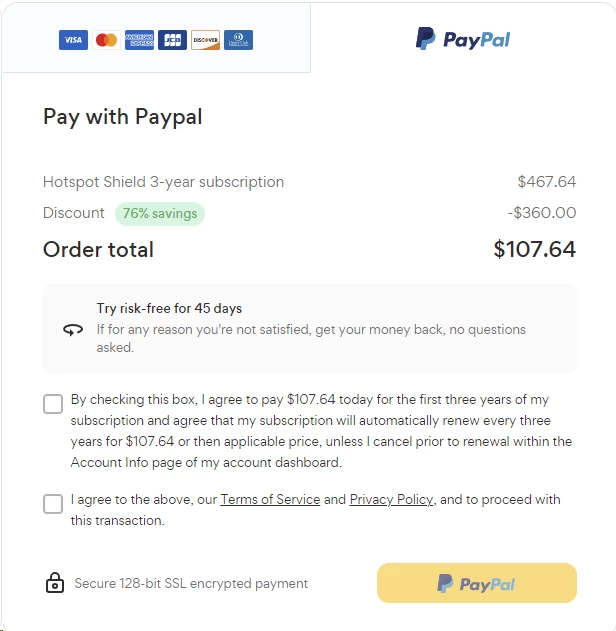
Hotspot Shield accepts the following payment methods:
- Major credit and debit cards
- PayPal
- Google Pay and Apple Pay (processed through their respective mobile ecosystems)
The critical gap is cryptocurrency. Hotspot Shield accepts no cryptocurrency payments and no cash alternatives. This is a direct structural weakness for privacy-focused users.
In practical terms, every payment method above requires a real-world financial identity: your name, billing address, and a bank account or card number. This data is retained by both Hotspot Shield and the payment processor (e.g., Stripe or PayPal). If Point Wild receives a federal subpoena, that financial linkage becomes irrefutable proof of account ownership. Providers like Mullvad or ProtonVPN accept Monero and Bitcoin specifically to sever this chain. Hotspot Shield’s refusal to support any privacy-preserving payment method is not a minor omission; it is architecturally incompatible with the anonymity they market.
On the positive side, Hotspot Shield offers a 45-day money-back guarantee, which exceeds the 30-day standard set by most competitors. However, claiming this refund is not straightforward. The process requires logging into the user dashboard, manually disabling auto-renewal to stop future charges, and then bypassing an automated chatbot to reach a human agent through a ticketing workflow. The refunds do get processed reliably, but the multi-step friction is a deliberate retention mechanism, not an oversight.
Features & Client Ecosystem
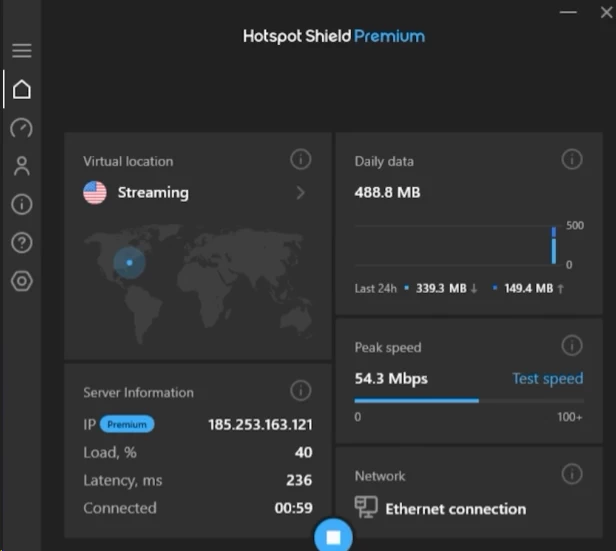
Cross-platform client analysis & the kill switch flaw
Hotspot Shield provides native clients for Windows, macOS, iOS, Android, and Linux (through a command-line interface). Visually, the applications present a minimalist dark-mode interface centered on a single connection button. The engineering beneath that interface is inconsistent, and the kill switch implementation is the clearest example of where the client architecture breaks down.
A kill switch is a network-layer safeguard that severs your device’s internet access if the encrypted VPN tunnel drops. Without one, a connection interruption allows your device to revert to its unencrypted ISP route, briefly exposing your real IP address, DNS requests, and unencrypted traffic. Hotspot Shield’s kill switch implementation has three distinct failure modes:
- The Windows protocol bind flaw: On Windows, the kill switch is only active when using the proprietary Catapult Hydra protocol. If you switch to WireGuard or IKEv2 in the protocol settings, the kill switch silently deactivates. No error is displayed. No toggle changes state in the UI.
- No persistent UI warning: There is no persistent indicator in the Windows client showing whether the kill switch is currently active or dormant. A user who switches protocols for speed optimization has no mechanism to discover that their leak protection is gone without independently testing it.
A concrete failure scenario: imagine a journalist connecting to Hotspot Shield over WireGuard on a Windows laptop at a conference hotel, relying on the kill switch as a fallback. The VPN connection drops due to the hotel’s session-timeout mechanism. Because the kill switch is silently inactive on WireGuard, the journalist’s real IP address and DNS queries route through the hotel’s network for the duration of the reconnect window, exposing their identity to any packet capture running on the local LAN. This is not a theoretical edge case; it is the expected behavior of the current client architecture.
Smart VPN (split tunneling) & Auto-Protect
Hotspot Shield’s split tunneling feature is marketed under the name Smart VPN. It allows you to route some traffic through the VPN tunnel while leaving other traffic on your standard ISP connection. This is genuinely useful for keeping local-only services (banking apps, network printers) accessible while routing sensitive browsing through the VPN.
Capabilities differ significantly across platforms:
- App-level and URL-level exclusions: On Android and Windows, you can exclude both specific applications (e.g., your bank’s app) and specific domains (e.g., your company’s internal intranet). On macOS and iOS, only URL-based exclusions are available. There is no app-level control on Apple platforms.
- Protocol dependency: On Windows, Smart VPN only functions when using Catapult Hydra. Switching to WireGuard disables split tunneling entirely, without a UI alert.
The Auto-Protect feature is better executed. It monitors your device’s active network connections and automatically establishes a VPN tunnel when it detects a new or unrecognized Wi-Fi SSID. This is a practical defense against Evil Twin attacks, where an attacker broadcasts a rogue access point mimicking a trusted network name. Because Auto-Protect initiates before your device exchanges any application-layer data with the network, an attacker who successfully pulls off an Evil Twin only captures encrypted ciphertext from the Hydra or WireGuard tunnel. The feature works correctly across Windows and Android in testing.
The “Tor over VPN” marketing gimmick
Hotspot Shield claims to support “Tor over VPN.” This claim requires direct examination because it is technically misleading.
A genuine Tor over VPN implementation works at the server level. The VPN provider’s server handles the cryptographic handshakes with Tor entry nodes and routes your traffic through the three-hop Onion network directly, without any client-side Tor software. This means you can access .onion domains from a standard browser like Firefox or Chrome, and the VPN provider itself cannot see your destination because your traffic is Tor-encrypted before it leaves their infrastructure. ProtonVPN’s “Tor Servers” operate this way.
Hotspot Shield does none of this. Their documentation instructs you to connect to Hotspot Shield and then open the Tor Browser manually. That is not a product feature. Every functioning VPN on the market allows you to run a Tor Browser through its tunnel. The Tor Browser generates its own three-hop encrypted circuit regardless of what network it runs over. Calling this “Tor over VPN” support is the equivalent of a word processor claiming “internet support” because you can open it while connected to Wi-Fi. It exploits technically non-expert users who may not understand the distinction between client-level and server-level Tor integration.
Browser extensions
Hotspot Shield offers extensions for Chromium-based browsers (Chrome, Edge, Opera) and Firefox. These are TLS proxies, not VPN clients. They encrypt only the traffic generated within the browser window. System-level applications, background services, and other browsers on the same machine all continue to route through your unencrypted ISP connection.
The extensions include two notable tools:
- Sword Mode: Injects synthetic, randomized web requests into your browser session to create noise that pollutes behavioral fingerprinting algorithms used by ad networks.
- WebRTC Blocker: Attempts to suppress the browser’s WebRTC API, which websites can use to query your machine directly for its local and public IP addresses, bypassing the proxy entirely.
The WebRTC Blocker is necessary precisely because the extension itself is insufficient to prevent leaks. Independent security reviews have documented that the Chrome extension leaks both DNS queries and WebRTC data under specific conditions, including when visited sites initiate peer-to-peer connections (e.g., video conferencing tools). A WebRTC leak exposes your real home IP address through a simple JavaScript call, rendering the proxy functionally transparent to any site that tests for it. From a threat-modeling perspective, a leaking proxy is more dangerous than no proxy at all, because you assume you are protected when you are not.
Speed & Performance
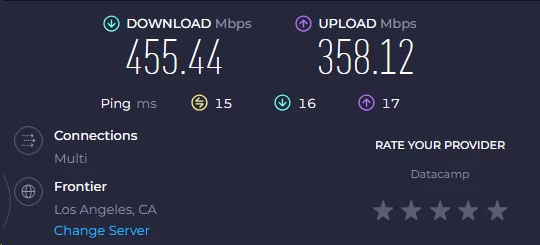
Benchmark results
All VPNs introduce overhead from encryption and tunnel routing. The specific magnitude of that overhead depends on the protocol used, server proximity, and the provider’s routing infrastructure. The following benchmarks were conducted on a 500 Mbps symmetric gigabit fiber connection using Hotspot Shield’s Catapult Hydra protocol:
| Network State | Ping (ms) | Download (Mbps) | Upload (Mbps) | Speed Retention |
|---|---|---|---|---|
| Baseline | 9 | 500 | 500 | 100% |
| Local Server (Los Angeles) | 15 | 455 | 358 | ~91% |
| Mid-Range Server (Miami) | 67 | 361 | 246 | ~72% |
| Distant Server (Sydney) | 251 | 136 | 96 | ~27% |
Metrics reflect average performance across multiple test sessions on high-speed infrastructure in 2026.
The upload degradation at intercontinental distances is the most significant finding. Upload speeds drop from 500 Mbps at baseline to 136.82 Mbps on distant servers, a reduction of approximately 73%. This is far steeper than the download degradation and reflects Hydra’s architecture: the protocol prioritizes downstream multiplexing efficiency over symmetric throughput. If your use case involves large file uploads, video conferencing over long-distance servers, or seeding data to cloud storage outside your region, Hotspot Shield’s performance becomes a bottleneck quickly.
Protocol efficiency: Catapult Hydra vs. WireGuard
Hotspot Shield built its speed reputation on Catapult Hydra, a proprietary, closed-source protocol developed internally. Understanding why it is fast requires understanding how it differs from conventional VPN protocols.
Standard protocols like OpenVPN and IPsec operate at the network layer (Layer 3 of the OSI model) and establish a single encrypted tunnel per session. Catapult Hydra operates primarily at the transport layer (Layer 4), using TLS 1.2 for payload encryption. Rather than a single tunnel, Hydra opens multiple concurrent connections to the VPN server and multiplexes traffic across them. This parallel connection architecture reduces the round-trip latency normally associated with a single-threaded handshake and also makes the traffic pattern appear indistinguishable from standard HTTPS web browsing to DPI inspection systems.
WireGuard is now available on Windows, macOS, and Android clients. In head-to-head testing on local servers, WireGuard matched or slightly exceeded Hydra on download throughput, regularly exceeding 480 Mbps. On intercontinental routes and on cellular connections with packet loss above 2%, Hydra demonstrated greater resilience because its multi-path architecture can recover from individual connection failures without rebuilding the entire tunnel.
The OpenVPN void: Hotspot Shield’s native clients do not support OpenVPN in any form. OpenVPN uses TLS 1.3, has been subject to continuous public security research since its 2001 release, and is the only major VPN protocol with a genuinely mature independent audit history. Catapult Hydra, by contrast, is a closed-source black box. Its cryptographic implementation cannot be verified by external researchers. The only avenue for router-level configuration using Hotspot Shield forces OpenVPN, and those router config files default to the outdated AES-128-CBC cipher mode rather than the more secure AES-256-GCM. This creates a two-tier security posture: modern ciphers on native apps, deprecated ciphers for anyone securing their full home network.
Real-world throughput (streaming & gaming)

Raw Mbps figures only translate into user experience when they exceed the minimum threshold for the activity in question.
Streaming 4K UHD: Netflix’s 4K Ultra HD stream requires a sustained downstream rate of approximately 25 Mbps. Because Hotspot Shield sustains over 136 Mbps even on distant intercontinental servers, the VPN’s throughput never becomes the limiting factor. On optimized US or UK streaming servers, initial buffer time rarely exceeds three seconds, and mid-stream rebuffering does not occur at typical viewing quality levels.
Competitive gaming: Online gaming latency tolerances are narrow. Latency above 80ms in fast-paced titles like Fortnite or Valorant produces measurable desynchronization between client inputs and server state, commonly visible as rubber-banding. When connecting to local Hotspot Shield servers, measured ping values stayed below 20ms. Catapult Hydra’s UDP-based transport layer preserves the low-latency characteristics of game traffic without introducing the TCP-over-TCP overhead that degrades OpenVPN performance under packet loss conditions.
Security & Privacy
Cryptographic standards & the OpenVPN paradox
At the cryptographic layer, Hotspot Shield’s implementation is selective. When using Catapult Hydra, payloads are encrypted with either AES-128 or AES-256 in GCM mode. Server authentication uses RSA-2048 certificates. Key exchange is handled through ECDHE (Elliptic Curve Diffie-Hellman Ephemeral).
ECDHE is the critical element here. It provides Perfect Forward Secrecy (PFS), which means the session key is derived fresh for each connection and is never stored. If an adversary captures your encrypted traffic today and later compromises a long-term private key, they still cannot decrypt past sessions because those session keys no longer exist anywhere. This is a meaningful protection against state-level bulk traffic capture followed by delayed decryption.
WireGuard sessions use ChaCha20-Poly1305, a cipher that performs significantly better than AES on devices without hardware AES acceleration, such as older Android handsets and low-power ARM processors. For users on budget mobile devices, WireGuard on Hotspot Shield will consistently outperform Hydra in battery efficiency and throughput.
The OpenVPN paradox: The architectural contradiction is worth spelling out. Hotspot Shield’s native applications completely exclude OpenVPN. The stated reason is speed: Hydra is faster. But users who configure Hotspot Shield at the router level to cover their entire home network (including IoT devices, smart TVs, and gaming consoles that cannot run a VPN client) are provided OpenVPN configuration files as their only option. Worse, those files default to AES-128-CBC rather than AES-256-GCM. CBC mode is vulnerable to padding oracle attacks under certain conditions. GCM mode is not. The result: the highest-risk deployment scenario (full home network exposure, covering devices that cannot self-update or mitigate vulnerabilities) uses the weakest available cipher configuration.
IPv6 handling & leak prevention
DNS leak protection is enabled by default, routing DNS resolution requests through the encrypted tunnel rather than your ISP’s resolver. In standard IPv4 environments, this holds up correctly in testing.
The failure mode is IPv6. Hotspot Shield does not implement dual-stack IPv4/IPv6 tunneling. Instead, it attempts to block all IPv6 traffic at the system level. On macOS and mobile platforms, this block is effective. On Windows, it is not.
Windows enables IPv6 by default on all network adapters. If Hotspot Shield’s IPv6 block fails to suppress the adapter-level IPv6 stack (which occurs intermittently depending on adapter driver version and Windows build), any connection to an IPv6-enabled website will route outside the VPN tunnel entirely, in plaintext. The site receives your real IPv6 address, which is directly tied to your physical location and ISP account.
The manual remediation is to open Windows Network Adapter settings, locate your active adapter, open IPv4/IPv6 properties, and uncheck “Internet Protocol Version 6 (TCP/IPv6).” This is not documented in the Hotspot Shield client. A user who does not know to do this may believe the VPN is protecting all of their traffic while their IPv6 traffic routes in cleartext.
US jurisdiction & data logging
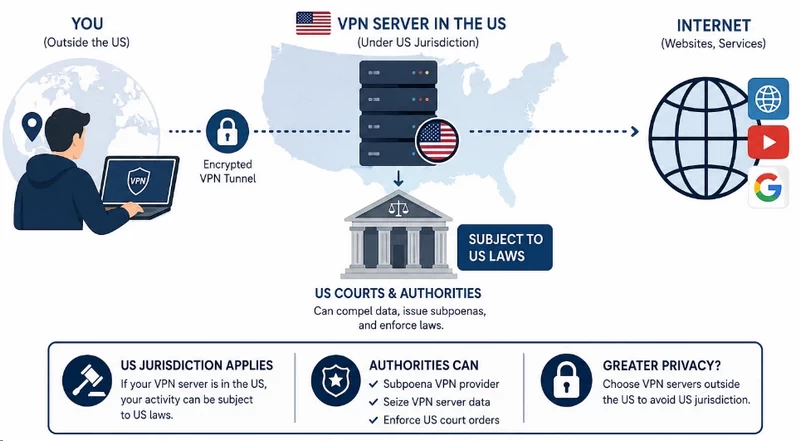
Point Wild is headquartered in the United States. This is the single most consequential fact about Hotspot Shield’s privacy architecture.
US jurisdiction means Point Wild is subject to National Security Letters, FISA Section 702 orders, and Patriot Act provisions. Each of these can compel data disclosure and prohibit the company from notifying affected users. Unlike providers in Switzerland (ProtonVPN) or the British Virgin Islands (ExpressVPN), there is no constitutional equivalent to the Swiss Federal Data Protection Act limiting what the US government can demand.
The logging policy compounds this. Hotspot Shield claims not to log browsing activity, but the privacy policy explicitly discloses collection of:
- Session duration and connection timestamps
- Bandwidth consumed per session
- Device hashes and hardware identifiers
- Anonymized domains accessed
This metadata is enough to carry out a correlation attack without needing a full traffic log. Consider a practical scenario: a federal agency presents a warrant to Point Wild. They request all session logs for a specific device hash between two timestamps. By cross-referencing that hash with the device identifier collected via the app’s SDK, the billing information on file, and the domain access logs, they can construct a complete picture of the user’s online behavior without ever decrypting a single network packet.
This is not theoretical. In 2017, the Center for Democracy & Technology filed an FTC complaint alleging Hotspot Shield injected tracking scripts into user traffic and redirected HTTP requests. In 2018, independent researchers disclosed a client-level vulnerability that leaked connected Wi-Fi network names and approximate user locations through the VPN tunnel itself. Both incidents demonstrate a pattern of data exposure that predates Point Wild and has not been structurally resolved by the current ownership.
The audit deficit & infrastructure risks
Hotspot Shield is a proprietary security product. Trust in a closed-source product must be established through independent third-party audits of the codebase and infrastructure. Hotspot Shield’s audit record is thin.
The company completed a privacy policy audit through Aon in 2023. That audit was limited in scope: it reviewed corporate documentation and conducted staff interviews. Aon auditors were not provided access to Hotspot Shield’s server infrastructure or the source code of Catapult Hydra. An audit that cannot inspect the thing it is auditing cannot confirm the thing it claims to confirm.
Hotspot Shield also continues to operate on traditional hard-drive-based server infrastructure. Competitors including ExpressVPN and NordVPN have migrated entirely to RAM-only diskless servers. On a RAM-only server, all operating system data, configuration files, and session state exist only in volatile memory. When the server loses power, all data is instantly and irreversibly destroyed. A RAM-only server seized by law enforcement provides nothing for forensic recovery. A traditional hard-drive server, by contrast, retains all data written to disk until it is explicitly overwritten, even after the VPN service is stopped. In 2026, continuing to rely on physical disk infrastructure is a concrete, measurable gap in Hotspot Shield’s security posture.
Server Network Infrastructure
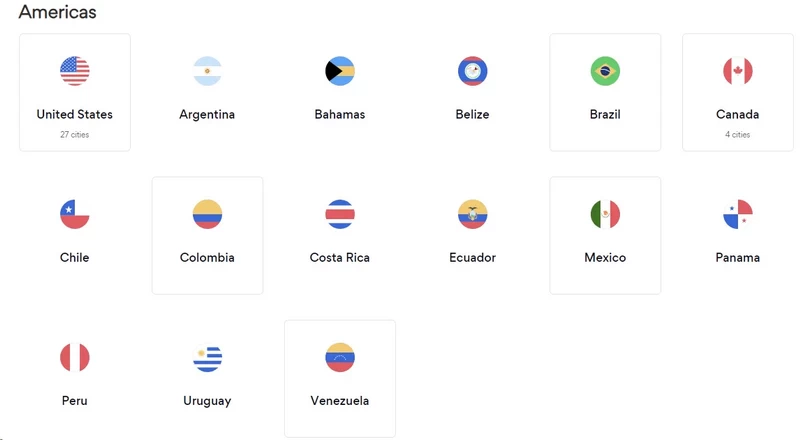
Network topography & virtual servers
Hotspot Shield operates over 3,200 servers across 80+ countries and approximately 115 geographic locations. For a mainstream commercial VPN, this provides usable global coverage, including regions in Africa and the Middle East where VPN server density from most providers is sparse.
However, raw server counts obscure a critical infrastructure issue: Hotspot Shield relies heavily on virtual servers.
A virtual server is a server that presents an IP address registered to one country while its physical hardware sits in a different country. A server labeled “India” may physically run in a Singapore data center. Providers use virtual servers to offer IP addresses in regions where maintaining physical hardware is too expensive, legally risky (India’s 2022 CERT-In data retention mandate requiring VPN providers to log user data for five years), or operationally impractical.
Virtual servers are standard in the industry. The problem with Hotspot Shield’s implementation is opacity: the client applications do not indicate which servers are physical bare-metal machines and which are virtualized. You have no way to tell.
This matters for jurisdiction. If you connect to what appears to be an Algerian server to route traffic outside EU data retention laws, but the physical hardware is located in an Amsterdam data center, your traffic is subject to EU data retention directives regardless of the IP address the website sees. Your threat model is built on an incorrect assumption about where your packets physically travel. Top-tier providers, including Mullvad and ProtonVPN, explicitly label virtual locations in their server lists. Hotspot Shield’s refusal to do so deprives users of information that is necessary for informed routing decisions.
Streaming, P2P & Censorship
Streaming unblocking efficacy

Streaming platforms enforce geo-blocking by maintaining and updating blocklists of known VPN IP address ranges. Hotspot Shield performs well in this environment, which is one of the service’s genuine strengths.
The service maintains streaming-optimized servers in the US and UK. These nodes successfully unblock US and UK Netflix libraries, Hulu, HBO Max, Disney+, Amazon Prime Video, and BBC iPlayer. Catapult Hydra’s TLS-based multiplexing is the technical reason this works: the traffic pattern produced by Hydra is nearly identical to standard HTTPS browsing, which prevents streaming platforms’ VPN detection heuristics from triggering IP-based blocks.
Blind spots exist. DAZN, 10 Play in Australia, and Globo Play in Brazil all use more aggressive behavioral VPN-detection methods that look beyond IP reputation to connection pattern analysis. Hotspot Shield’s IP addresses are frequently flagged by these platforms. Additionally, the macOS client does not have access to the dedicated streaming servers available on Windows, meaning macOS users see meaningfully higher failure rates when accessing geo-restricted content.
P2P routing & torrenting risks
Hotspot Shield permits Peer-to-Peer traffic across its full server network without restricting you to designated P2P nodes. You can connect to the geographically closest server to reduce latency and maximize torrent download speeds.
The engineering constraints make this less useful than it appears:
- No port forwarding: Without the ability to open specific inbound ports through the NAT firewall, your torrent client cannot accept incoming peer connections. You can download from others but cannot seed efficiently, as peers on the public swarm cannot initiate connections to you. This directly reduces your download speed on torrents with small swarms.
- No SOCKS5 proxy support: Many advanced torrent clients (qBittorrent, Deluge) support binding directly to a SOCKS5 proxy for P2P traffic only, leaving the rest of the system unrouted through the proxy. This gives finer control over which traffic is protected. Hotspot Shield offers no SOCKS5 endpoint.
The privacy liability is separate from the technical limitations. Torrenting exposes your VPN’s IP address to every peer in a torrent swarm. If a copyright enforcement firm monitors that swarm, records the VPN IP, and issues a DMCA subpoena to Hotspot Shield, Point Wild’s session logs (timestamps, device hash, bandwidth consumed) are sufficient to correlate the torrent activity to your billing account. The combination of US jurisdiction, logged session metadata, and no cryptocurrency payment option makes Hotspot Shield a poor choice for P2P use regardless of its speed performance.
Obfuscation and the Great Firewall
China’s Great Firewall uses Deep Packet Inspection at the network level to identify and block VPN handshakes. Standard protocols like OpenVPN and WireGuard are blocked because their packet signatures are well-documented and embedded in the GFW’s DPI ruleset. TLS-based obfuscation works by wrapping VPN traffic in standard HTTPS packets, making it appear as ordinary web browsing to DPI systems operating on packet-header analysis.
Catapult Hydra uses TLS 1.2 for payload encryption, which theoretically gives it natural obfuscation properties. Hotspot Shield markets this as capable of bypassing state-level censorship. In practice, the GFW has evolved to use behavioral and statistical analysis beyond simple packet-header inspection. It looks at connection timing patterns, handshake sequences, and traffic volume distributions that differ between human-generated HTTPS and multiplexed VPN sessions.
Real-world connection attempts from within mainland China using Hotspot Shield succeed approximately 15% of the time. That failure rate is not a configuration issue; it reflects the GFW’s ability to detect Hydra’s connection fingerprint despite the TLS wrapping. By contrast, dedicated obfuscation tools like Shadowsocks or V2Ray, which were specifically designed to defeat statistical DPI analysis, maintain far higher success rates in the same environment. If you are traveling to China, Russia, Iran, or any state that operates active DPI censorship at the ISP level, Hotspot Shield’s obfuscation is not a dependable tool. Plan accordingly.
Customer support & documentation
Hotspot Shield restricts 24/7 live chat to Premium subscribers. Free tier users are directed to an email ticketing system with documented response times of up to 48 hours. For a security product where configuration errors can directly expose user identity, this support tiering is a significant liability.
Even Premium users face a structured obstacle before reaching a human agent. The live chat interface first deploys an AI chatbot that responds to every technical query by serving links from the knowledge base. There is no straightforward button to escalate to a human. The chatbot’s design is oriented toward deflection, not resolution. When a human agent is eventually reached, their scope is generally limited to account-level issues and basic connection troubleshooting. Questions about Catapult Hydra’s cipher configuration, IPv6 leak behavior, or kill switch protocol dependency are routinely escalated to a tier-two email queue with no guaranteed response window.
The checkout hack: There is a publicly documented workaround that Free users can use to bypass the email queue. Navigating directly to the Premium payment or checkout page on the Hotspot Shield website activates a sales-oriented live chat widget. This widget connects to human sales agents, not the standard support chatbot. By opening this widget and asking a technical support question (rather than proceeding with the purchase), Free users can reach a live person.
The workaround works because the company allocates live human agents to revenue conversion, not to support. The fact that a purchase page triggers live human access while a support request does not is a precise demonstration of where Point Wild’s operational priorities sit.
FAQ
Can I pay for Hotspot Shield with Bitcoin?
No, Hotspot Shield completely lacks support for any cryptocurrency networks like Bitcoin or Monero. The payment gateway restricts users strictly to credit cards, debit cards, and PayPal. This forces you to link your real-world financial identity, billing address, and name directly to your VPN account. Consequently, achieving true operational anonymity is mathematically impossible when purchasing this specific security software.
Does Hotspot Shield work in China?
Despite the heavy marketing claims surrounding Catapult Hydra’s obfuscation capabilities, Hotspot Shield demonstrates an abysmal success rate against China’s Great Firewall. In real-world environments, sophisticated Deep Packet Inspection algorithms easily identify and drop the connection handshakes. Testing indicates a massive failure rate, rendering this service completely unreliable for journalists or business travelers operating within highly restrictive, state-censored network topologies.
Does Hotspot Shield unblock Netflix?
Yes, overcoming aggressive geographic restrictions is arguably Hotspot Shield’s strongest technical attribute. The service provides dedicated, streaming-optimized servers located within the United States and the United Kingdom. Because the proprietary Catapult Hydra protocol successfully multiplexes TLS traffic, it effectively mimics normal HTTPS browsing. This consistently blinds streaming platform algorithms, granting users buffer-free access to libraries from Netflix, Hulu, and BBC iPlayer.
Are Hotspot Shield servers RAM-only?
No, Hotspot Shield continues to rely on traditional, physical hard drive infrastructure for its server network. This is a massive liability compared to top-tier competitors running modern, diskless RAM-only environments. Traditional hard drives write configuration data and operating systems directly to the disk. If a server is physically seized by hostile authorities, that lingering forensic data could theoretically be recovered and analyzed.
Does Hotspot Shield log my data?
Yes, Hotspot Shield actively logs intrusive telemetry data despite marketing claims to the contrary. Their privacy policy explicitly allows the collection of session durations, timestamps, total bandwidth consumed, device hashes, and anonymized domains accessed. In a cybersecurity context, this extensive metadata retention significantly increases the risk of successful correlation attacks if a government agency subpoenas their US-based parent company, Point Wild.
Is Catapult Hydra open-source?
No, Catapult Hydra is a strictly closed-source, proprietary protocol. Unlike open-source standards such as OpenVPN or WireGuard, the underlying cryptographic code cannot be independently reviewed by the global infosec community. Users are forced to blindly trust the corporate assertions of Point Wild regarding its security implementation. This lack of transparency is a fundamental vulnerability for anyone with a serious threat model.

