
CyberGhost VPN Review 2026: The Honest Breakdown of Speed and Privacy
| 💰 Pricing | From $2.19 to $12.99/mo |
| ✅ Free Trial | ✅ |
| 📆 Money Back Guarantee | 45 Days |
| 🗺 Jurisdiction | Romania |
| 🖥 Number of Servers | 11000+ |
| 📝 Logging Policy | No‑logs |
| 📥 Torrenting/P2P | ✅ |
| 🍿 Streaming | Unblocks Netflix, BBC iPlayer, Hulu etc |
| 🛡 Kill Switch | ✅ |
| ⚙️ Protocols | OpenVPN, WireGuard®, IKEv2/IPsec, L2TP/IPsec, |
| 🛠 Support | 24/7 Live Chat Support |
| 💻 Simultaneous Devices | 7 devices |
| 🔥 Current Deal | 84% OFF (on 2-year plan) |

Overview
Jurisdiction: The Structural Argument That Actually Holds
CyberGhost is headquartered in Romania, and the privacy implications are concrete. Romania sits outside the 14 Eyes intelligence-sharing alliance, which means no legal framework exists compelling the company to hand over user data to foreign governments under mutual legal assistance treaties. Romanian law imposes no data retention mandates on VPN providers – unlike Germany, the UK, or France, which have all enacted ISP-level logging requirements at various points.
The Kape Problem: Who Actually Owns This
Then the ownership picture complicates everything. Kape Technologies – formerly Crossrider – acquired CyberGhost in 2017. The rebrand wasn’t cosmetic: Crossrider’s original platform had documented exploitation by adware distributors and browser hijacking campaigns, with security researchers cataloguing the abuse at scale. Kape has since repositioned as a “digital privacy company,” acquiring Private Internet Access, ExpressVPN, and review platform Privacyco in the process. That last acquisition is the most structurally uncomfortable – a single corporate entity controlling both VPN products and the review infrastructure rating those products.
To be precise: Kape’s ownership does not automatically invalidate CyberGhost’s technical privacy architecture. The Romanian jurisdiction applies regardless of corporate parentage. No confirmed data-handover incidents have occurred post-acquisition. But the conflict of interest embedded in owning both privacy products and their review coverage demands direct acknowledgment rather than a footnote. A company that once profited from adware distribution now sells privacy infrastructure. The burden of proof is on them, and independent auditing – not corporate assurances – is how that proof gets established.
Platform Parity – The Windows vs. macOS Divide
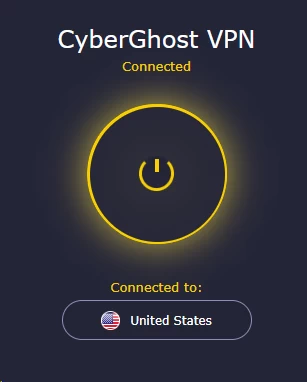
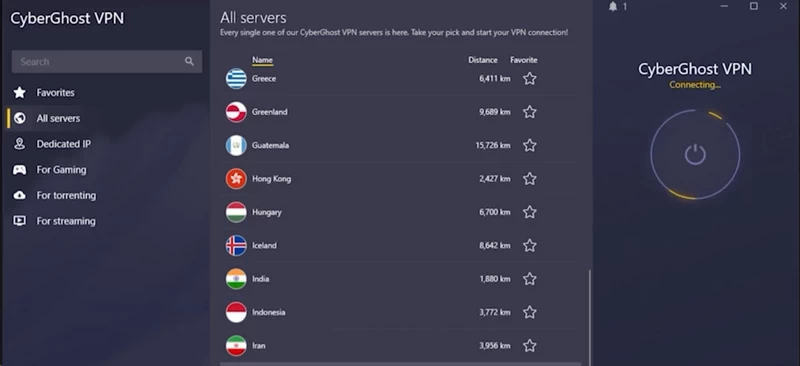
CyberGhost’s identity crisis is most visible in the gap between its platform implementations. The Windows client is a finished, feature-complete product: a structured server browser, dedicated streaming and torrenting profiles, fully functional Smart Rules automation, and an app-based split tunneling implementation that operates without requiring a restart to apply changes. It reflects concentrated engineering investment.
The macOS client is a different product in a critical way. Split tunneling is absent entirely – not limited, not simplified, absent. The Smart Rules feature set is visibly reduced. Configuration options that Windows users treat as standard are missing or inaccessible. For a service charging the same subscription price across platforms, shipping a materially degraded macOS experience is a resource allocation decision that reveals internal priorities plainly.
The iOS app extends this pattern. Core connectivity works – server selection, protocol switching, basic connection management – but the labeled streaming servers, P2P-optimized routing, and granular automation that justify choosing CyberGhost over cheaper alternatives are either stripped back or absent. A VPN’s value in a multi-device household depends entirely on cross-platform feature consistency. CyberGhost fails that test.
Pricing & Plans

Pricing Reality Check
CyberGhost’s pricing architecture is engineered to push users toward long-term commitment. The gap between monthly and multi-year pricing is among the widest in the premium VPN segment – a deliberate anchor strategy where the monthly price functions as a deterrent rather than a serious purchase option.
| Plan | Monthly Cost | Total Billed | Renewal Rate |
|---|---|---|---|
| 1 Month | $12.99/mo | $12.99 | $12.99/mo |
| 6 Months | $6.99/mo | $41.94 | Higher |
| 2 Years + 2 Months | $2.19/mo | $56.94 | Increases significantly |
The $2.19/month introductory rate on the 2-year + 2-month plan is genuinely competitive within the premium VPN tier. Seven simultaneous device connections at that rate makes the math defensible – though Surfshark offers unlimited connections at comparable pricing, which is the direct competitive pressure CyberGhost doesn’t address in its marketing.
The Monthly Plan as a Price Trap
The $12.99/month figure for the monthly plan is not a good-faith price for sustained use. At that rate, CyberGhost competes against providers with faster long-distance server performance, more consistent cross-platform feature sets, and no gap in macOS split tunneling. The monthly plan exists to make the 2-year option appear as relief, not to serve users with legitimate short-term needs at fair value. Users traveling for a month or testing before a longer commitment absorb a pricing penalty that the competitive landscape does not require.
Renewal Pricing: What the Headline Rate Conceals
The introductory rate on long-term plans does not persist. Renewal pricing increases substantially after the initial term, and CyberGhost’s billing page does not lead with that disclosure. This is industry-standard practice, but standard does not mean acceptable – check the renewal rate before interpreting the $2.19 headline as a long-term cost. It is an acquisition price, not a retention price.
The 45-Day Guarantee Catch
What the 45-Day Headline Actually Covers
CyberGhost advertises a 45-day money-back guarantee, which exceeds the market standard of 30 days. The window is long enough to test streaming server performance across multiple platforms, evaluate speed consistency across different geographic server categories, and stress-test the kill switch under real network conditions. The number is legitimately useful – with a condition that changes its value significantly depending on which plan you purchased.
The 14-Day Trap on the Monthly Plan
The 45-day window applies exclusively to long-term plans – 6-month and 2-year subscriptions. The 1-month plan carries a 14-day refund window. Not 30 days. Fourteen. That is below the industry standard the 45-day headline implies, and it applies to the plan that already charges the highest per-month rate. CyberGhost charges maximum per-month pricing while simultaneously providing minimum evaluation time on that same plan. The math on that combination is not flattering.
The practical consequence: users who want adequate time to evaluate the service must commit to a long-term plan upfront. Purchasing the 1-month plan as an evaluation vehicle – the logical choice for an undecided user – gives you less than half the evaluation window and costs you the highest monthly rate. Whether this is deliberate friction design or accidental policy misalignment is irrelevant; the outcome is identical either way.
Refund Process: What to Expect
Refund processing via customer support runs without reported systematic friction for users within the eligible window on qualifying plans. The actual obstacle is the first step: determining which plan you purchased and which window applies. Review your purchase confirmation email, confirm the plan type and purchase date, and verify your eligibility before initiating contact. The support process has no meaningful barriers once you’ve cleared the eligibility question – that’s where most users trip up.
Features & Apps
Conditional Automation: How Smart Rules Actually Works
On Windows, Smart Rules is the feature that separates CyberGhost from the crowded mid-tier VPN market. Standard VPN clients provide an on/off switch and a server list. Smart Rules provides a conditional logic engine: define a trigger, define a server response, and the VPN operates as an automated system rather than a manual tool dependent on user memory. For users who invest in configuration, this architecture alone justifies the subscription over less-featured alternatives at equivalent pricing.
The trigger categories deliver genuine operational depth:
- App launch – automatically routes a specified application through a designated server profile the moment it opens. A torrent client fires up, Smart Rules connects to a P2P-optimized Romanian server without a manual VPN interaction.
- Wi-Fi network detection – connects automatically on unrecognized or untrusted networks; whitelisted networks (home, office) bypass the trigger.
- Network type – differentiates behavior between open public Wi-Fi and secured private networks at the protocol level.
- Startup behavior – defines whether CyberGhost launches with Windows and whether it auto-connects or waits for manual activation.
- Specific server memory – pairs a trigger with a saved server rather than any server, critical for streaming profiles where IP consistency across sessions affects platform authentication.
The macOS Gap That Undermines the Feature
A realistic power-user Windows configuration runs without a single manual click post-setup: torrent client routes to a P2P-optimized server; browser tunnels on public Wi-Fi, bypasses on the home network; kill switch arms automatically. That workflow is unavailable on macOS. Smart Rules on Mac is a stripped implementation that removes the trigger depth that makes the Windows version architecturally valuable. A feature this well-designed, left to atrophy across the platform that represents a substantial portion of CyberGhost’s user base, reflects a development prioritization decision that the service’s premium pricing doesn’t justify.
The “7 Devices” Headache
CyberGhost permits 7 simultaneous connections – accurate as stated and misleading in practice. The service tracks registered devices, not active concurrent sessions. When you install the app on a machine and authenticate, that machine consumes a device slot. The slot is not released automatically when you uninstall, reset, or reinstall the OS on that machine. A fresh Windows installation on the same physical hardware may register as a new device, consuming a second slot while the old registration persists.
Split Tunneling
Split tunneling on CyberGhost operates on an app-exclusion model – specify which applications bypass the VPN tunnel; everything else routes through by default. This is the more operationally practical configuration direction for most users, since the list of applications requiring local-network access (printer utilities, corporate intranet clients, anti-cheat systems) is typically shorter than the list requiring VPN protection. The Windows implementation applies changes without requiring a restart – a baseline expectation that some competitors still fail to meet.
On macOS, split tunneling does not exist. This is not a reduced implementation or a simplified interface – the feature is architecturally absent from the Mac client. Competing services including NordVPN, ExpressVPN, and Mullvad implement app-level routing on macOS. CyberGhost’s absence on this capability is a product decision, not a technical constraint imposed by the platform.
Kill Switch Behavior and the Disconnect Requirement
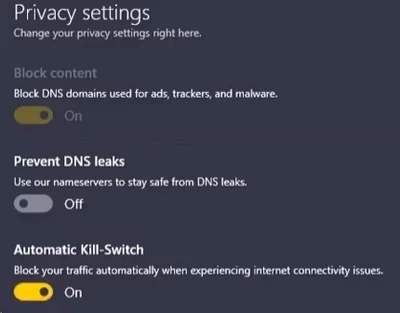
The Kill Switch on Windows functions correctly under its primary design constraint: when the VPN connection drops, internet access cuts to prevent real-IP exposure during an unprotected interval. The non-standard behavior is the toggle mechanism. With the kill switch enabled and the VPN connected, you cannot disable the kill switch without first disconnecting the VPN session. For users who maintain the kill switch in a permanently armed state – which is the correct security posture for most threat models – this is a non-issue. For users who need to temporarily disable it without dropping the tunnel, this creates friction that competing clients don’t impose.
Network Protection – CyberGhost’s always-on continuous tunnel enforcement mode – layers on top of the kill switch to maintain uninterrupted VPN coverage across connection interruptions. Configured together, the two features form a robust stack for threat models where any unprotected traffic interval is unacceptable. On Windows, this implementation is genuinely solid. On macOS, neither feature is available in its full form – which remains the defining limitation of the product’s cross-platform security story.
Token-Based Dedicated IPs
Dedicated IP addresses in most VPN services create an explicit identity linkage: the provider maintains a record mapping a specific customer account to a specific IP address. That mapping is the data record. A legal demand, infrastructure compromise, or insider access to that database resolves directly to subscriber identity. CyberGhost’s token-based IP architecture is a structural attempt to break that linkage – and understanding the mechanism matters more than the marketing label.
How Token Decoupling Works
When you purchase a dedicated IP, the transaction generates a randomized token that is cryptographically decoupled from your account credentials. You use the token to activate the IP; CyberGhost’s infrastructure does not maintain a lookup table connecting that token to your account identity. The IP assignment and subscriber identity exist in separate systems without a direct relational link.
The practical implication: if CyberGhost’s servers were compromised or subject to a legal production demand, the answer to “which subscriber owns this IP address” is structurally unavailable – not withheld as a policy matter, but absent by design. A no-logs policy is a promise enforceable only by the willingness of the company to keep it. A token architecture that never creates the mapping in the first place is a technical constraint. Technical constraints hold under legal and operational pressure in ways that policy commitments cannot guarantee.
The scope limitation deserves equal clarity: token decoupling addresses the IP-ownership linkage specifically. Connection timestamps, server selections, and bandwidth records fall under CyberGhost’s separate no-logs policy rather than the token architecture. For users with legitimate need for a static IP that doesn’t create an identity trail, this implementation is among the more technically credible options in the consumer VPN market – but it is not a substitute for auditing the full logging infrastructure.
Speed & Performance
Protocol Selection: What Each Option Actually Delivers
CyberGhost’s Windows client ships WireGuard, OpenVPN UDP, OpenVPN TCP, IKEv2, and L2TP/IPSec. That range covers the full spectrum from modern cryptographic efficiency to legacy compatibility, which is the correct approach for a broad consumer base. WireGuard is the default and should be – it achieves AES-256 equivalent security through ChaCha20 encryption with substantially lower handshake overhead than OpenVPN, translating to faster connection establishment and less CPU cost on mobile hardware.
OpenVPN UDP is the appropriate fallback for networks where WireGuard traffic receives active throttling – corporate firewall environments, certain hotel Wi-Fi configurations, and ISPs that flag non-standard UDP traffic patterns. OpenVPN TCP sacrifices some throughput for reliability on networks with aggressive packet filtering, useful in specific network environments and unnecessary in most others. The protocol switching interface is accessible without menu navigation, meeting the basic UX standard that some VPN clients still miss.
IKEv2 for Mobile and the OpenVPN Gap on Apple
IKEv2 performs best in mobile scenarios involving frequent network handoffs between Wi-Fi and cellular. The protocol’s MOBIKE extension maintains session continuity across network transitions without requiring reconnection – an advantage over WireGuard, which currently handles rapid network handoffs less gracefully. CyberGhost includes IKEv2 on iOS and Windows, making it operationally useful rather than a feature-list checkbox. The absence of OpenVPN on macOS and iOS is a practical gap: Apple platform restrictions complicate the implementation, but competing providers navigate those restrictions, and users who require OpenVPN for specific network compatibility reasons lose that option on Apple hardware.
L2TP/IPSec is legacy infrastructure. Its inclusion accommodates older enterprise environments and router-level VPN configurations, not everyday use. The encryption overhead is unnecessary when WireGuard achieves stronger security at significantly lower computational cost. CyberGhost’s documentation should be more direct about steering users away from L2TP as a default – it currently treats it as an equal option when it isn’t.
Speed Test Reality
Speed results provide the most honest performance signal available, and CyberGhost’s numbers reflect a service that performs well on proximate servers and progressively less well as routing distance increases.
| Test Scenario | Download Speed | Upload Speed | Ping | Speed Retained |
|---|---|---|---|---|
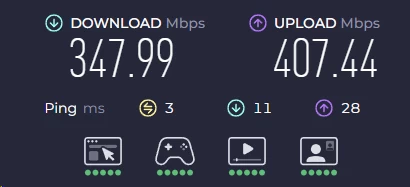
| Base (No VPN) | 347 Mbps | 407 Mbps | 3 ms | 100% |
| Local Server (US) | 312 Mbps | 270 Mbps | 7 ms | ~89% |
| UK Server | 213 Mbps | 168 Mbps | 89 ms | ~61% |
| Australia Server | 81 Mbps | 75 Mbps | 278 ms | ~23% |
~89% speed retention on a US local server with a 4ms ping increase is competitive with the top tier of the consumer VPN market. WireGuard’s reduced handshake overhead is measurable in that result. For everyday use cases – streaming, browsing, file transfer under 300 Mbps – the local server performance is functionally indistinguishable from an unprotected baseline connection.
Transatlantic and Long-Haul: Where the Gap Opens
270 Mbps on the US server – approximately 61% of baseline – places CyberGhost in the mid-tier rather than the top of its competitive set for transatlantic connections. The throughput is sufficient for 4K streaming and most practical workloads. Users on gigabit home connections who expect near-baseline performance on distant servers will feel the overhead, and competing providers with more aggressively optimized server fleets on the same transatlantic routes post better numbers. CyberGhost is not losing this comparison badly; it is not winning it.
81 Mbps at 278ms to Australia is a significant degradation. Retaining ~35% of baseline on intercontinental routing reflects physics constraints that no VPN provider fully escapes, but some handle substantially better through smarter routing logic and optimized server placement closer to undersea cable landing points. If your regular use case involves consistent connections to servers on the opposite side of the planet, these numbers warrant comparison-shopping before committing.
What “Gaming-Optimized” Actually Means in Testing

CyberGhost labels a server category for gaming, visually segmented from general-purpose and streaming/P2P pools in the UI. The underlying premise – that gaming traffic’s latency sensitivity benefits from lower-congestion, more directly peered server infrastructure – is technically sound. Whether the label reflects genuine infrastructure differentiation or UI segmentation is the operative question.
Testing data shows lower ping figures on gaming servers versus equivalent general-purpose servers in the same geographic region, which suggests routing or peering differentiation rather than pure relabeling. On US-to-US gaming server connections, 7-15ms ping is achievable – acceptable for most competitive multiplayer scenarios where the game server’s own network introduces its own latency floor. The VPN overhead on local gaming infrastructure is not the performance bottleneck.
The Latency Reality Check
The constraint no gaming server label circumvents: a VPN adds latency; it does not reduce it. CyberGhost’s gaming servers minimize overhead relative to its general pool – they cannot produce lower ping than your direct unprotected connection to the game server. The legitimate use case for gaming through a VPN is IP masking during competitive sessions to mitigate targeted DDoS attacks – not speed improvement. CyberGhost’s own long-distance performance numbers support that conclusion. Anyone selling you a VPN on ping improvement claims is misrepresenting what the technology can do, regardless of provider.
P2P Server Infrastructure and Protocol Overhead
CyberGhost explicitly supports P2P traffic through dedicated P2P-optimized servers – a clear policy stance in a market where several competitors quietly throttle torrent traffic or bury usage restrictions in terms of service. The server category is labeled in the UI, and Smart Rules automation can route a torrent client to the appropriate server profile the moment the application launches, eliminating the manual activation step where real-IP exposure most commonly occurs.
P2P performance on proximate US servers tracks the general local server profile – the P2P category doesn’t introduce meaningful additional overhead beyond the baseline speed test numbers for that region. For users in Western Europe connecting to European P2P servers, the practical experience is functionally competitive with other mid-tier VPN services.
Why Ping Matters More for P2P Than Streaming
Distance compounds differently for BitTorrent than for HTTP streaming. A 89 Mbps connection to an Australian server handles 4K streaming acceptably at around 25 Mbps sustained. That same 89 Mbps on a 278ms round-trip connection degrades BitTorrent’s real-world download rate more severely than the bandwidth figure implies, because the protocol requires continuous bidirectional coordination – swarm management, tracker polling, peer connection negotiation – that accumulates latency penalty multiplicatively. Use P2P servers within your geographic region; CyberGhost’s P2P server list is extensive enough in North America and Europe that finding a nearby optimized server is not a practical constraint.
Security & Privacy
NoSpy Servers Explained
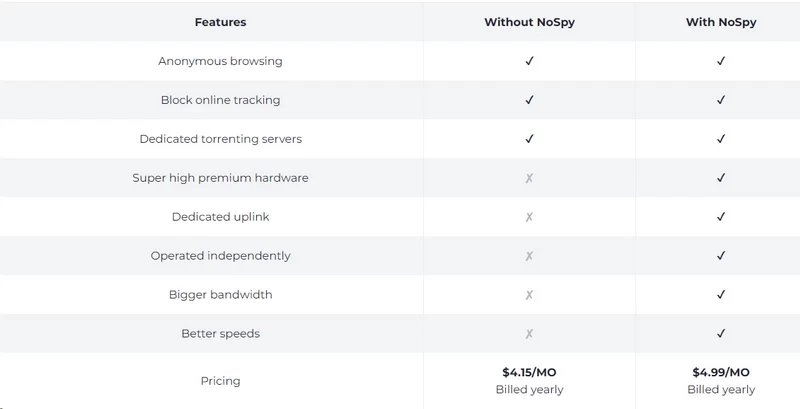
NoSpy servers are CyberGhost’s premium server tier, physically located in Romania and operated on infrastructure CyberGhost claims to own outright rather than lease from third-party colocation providers. The distinction has operational security implications that extend beyond the marketing positioning. Standard VPN server deployment involves renting rack space in colocation facilities, which introduces physical access vectors outside the VPN provider’s direct control: data center personnel with facility-level access, shared infrastructure where neighboring equipment belongs to entities with different threat relationships, and third-party management systems with their own credential and logging infrastructure.
When CyberGhost controls the physical hardware directly, those attack surface elements are removed from the equation. No colocation staff access. No shared facility management systems. No third-party legal exposure through a data center operator. For threat models that include physical interdiction by sophisticated adversaries – government agencies with warrant authority in the hosting jurisdiction, intelligence services with physical access capabilities – the difference between leased and owned infrastructure is a concrete security variable, not an abstract marketing claim.
Romanian Jurisdiction in Practice
The Romanian jurisdiction compounds the infrastructure advantage. Legal demands for NoSpy server data require Romanian legal process; they cannot be satisfied unilaterally by foreign intelligence agencies using domestic instruments like the US National Security Letter system or UK production orders. Romania has no mandatory data retention law applicable to VPN providers. A NoSpy server in Romania, physically controlled by CyberGhost, minimizes the chain of custody between user data and potential compromise – which is the correct structural direction for privacy infrastructure.
The honest cost accounting: NoSpy servers are a premium add-on. For users whose threat model is ISP behavioral profiling, streaming geo-restrictions, or public Wi-Fi interception, the standard server pool addresses those threats adequately and the NoSpy premium buys nothing operationally relevant. For journalists, activists, or anyone operating against an adversary with physical infrastructure access capabilities, the additional expenditure is rational security investment. For the other 95% of the subscriber base, it remains unused insurance.
The Deloitte Audit & RAM-Only Network
In 2022, CyberGhost commissioned an independent infrastructure audit from Deloitte – a firm whose professional liability is not contingent on VPN industry relationships and whose findings carry reputational weight proportional to its scale. The audit examined server infrastructure and operational practices against the stated no-logs policy, confirming that CyberGhost’s infrastructure operates consistently with those claims: no user-identifying connection logs, no traffic content retention, no data enabling reconstruction of individual browsing activity from server records.
The Structural Limitations of Point-in-Time Audits
Independent audits are not permanent certifications. They represent a point-in-time assessment of infrastructure as presented to auditors with defined access scope. A motivated operator could theoretically pass an audit while maintaining logging capabilities in systems outside the audit perimeter. This is not an accusation directed at CyberGhost – it is a structural limitation that applies universally across every VPN audit, and any review that presents an audit as a comprehensive and ongoing guarantee is oversimplifying.
What the Deloitte engagement provides is meaningful accountability friction. Engaging Deloitte rather than a smaller, industry-adjacent firm signals willingness to subject infrastructure to scrutiny from an organization whose professional credibility is independent of VPN market relationships. A finding of inconsistency would generate reputational consequences for Deloitte, not just CyberGhost – that asymmetry creates genuine incentive for honest reporting. That is the maximum structural assurance a third-party audit can provide, and it is more meaningful than a self-attestation.
RAM-Only Infrastructure: The Physical Seizure Defense
RAM-only servers address a specific persistence vulnerability that conventional storage infrastructure leaves unresolved. On a hard-drive-based server, data written during operation accumulates on disk and survives normal shutdown cycles – connection artifacts, temporary records, and system logs persist until explicitly overwritten. A server seizure gives law enforcement or intelligence agencies an image of everything written since the last deliberate wipe. RAM-only infrastructure eliminates this entirely: volatile memory loses all contents the moment power is removed, meaning physical seizure of the hardware produces no recoverable operational history. CyberGhost’s migration toward diskless servers across its network closes the physical seizure threat vector at the infrastructure level – a technical control that operates independently of the no-logs policy that governs the software layer.
The “Ad-Blocker” Illusion
CyberGhost’s “Block Content” feature is positioned in ways that invite comparison to browser-level ad-blocking tools. The technical description is precise: this is a DNS-based domain filter. When a DNS resolution request is made for a domain on CyberGhost’s blocklist, the filter returns a null response rather than resolving the address. That is the complete scope of what the feature does.
What DNS Filtering Cannot Block
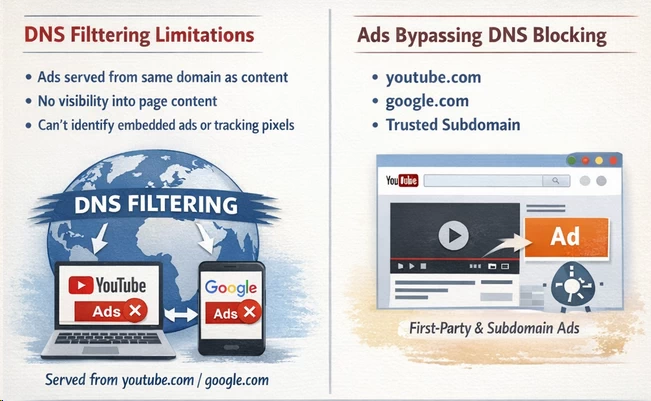
DNS filtering cannot block ads served from the same domain as the content being requested. If advertising assets are served directly from google.com or youtube.com – which is increasingly the operational pattern for platforms that have adapted specifically to circumvent DNS-level blocking – the filter cannot distinguish that request from a legitimate content request without breaking the underlying service. It operates at the domain level; it has no visibility into page content, cannot identify ad-network elements embedded in first-party responses, and cannot process tracking pixels served from trusted subdomains. uBlock Origin operates at the content layer after page assembly – it sees the complete DOM and surgically removes elements matching ad signatures. Those are fundamentally different architectures solving different problems.
Where DNS Filtering Actually Delivers Value
The malicious domain blocking component of this feature is genuinely useful and deserves separate evaluation from the ad-blocking positioning. Blocking DNS resolution to known malware distribution infrastructure, phishing domains, and command-and-control server addresses at the network layer provides a meaningful defensive layer, particularly for non-technical users without dedicated endpoint security software. Preventing a device from resolving a known phishing domain is a real security function. CyberGhost’s implementation of this capability adds concrete value to the subscription.
The problem is positioning. Calling this feature an ad-blocker – or bundling it alongside ad-blocking in marketing materials – creates user expectations the technical implementation cannot meet. Users who enable it believing they’ve replaced a browser extension will encounter pre-roll ads on YouTube, sponsored content in Google search results, and tracking infrastructure that DNS filtering cannot address. The accurate feature description is “DNS-based malware and phishing domain filter with incidental blocking of dedicated ad-serving domains.” That description represents a useful security function. The current framing is the same function described in a way that will systematically disappoint users who take the marketing at face value.
Servers & Locations
11,000+ Servers – Does Size Actually Matter?
CyberGhost’s 11,700+ servers across 100 countries leads every marketing touchpoint. The instinct to interrogate the number rather than accept it is correct – raw server count is the VPN metric most susceptible to engineering for appearance rather than performance. Understanding what those 11,700 servers represent requires asking questions the promotional materials don’t volunteer.
The 100-country geographic coverage is genuinely broad. For users whose access requirements extend beyond the standard US/UK/Germany triumvirate – researchers needing in-country IP addresses for specific markets, travelers requiring access to home content from less-served regions – that distribution translates to real utility. A 500-server network in 10 countries is meaningfully less capable for global access scenarios. On geographic distribution, the large network reflects actual coverage rather than server-farm inflation in high-demand corridors.
The Virtual Server Transparency Problem
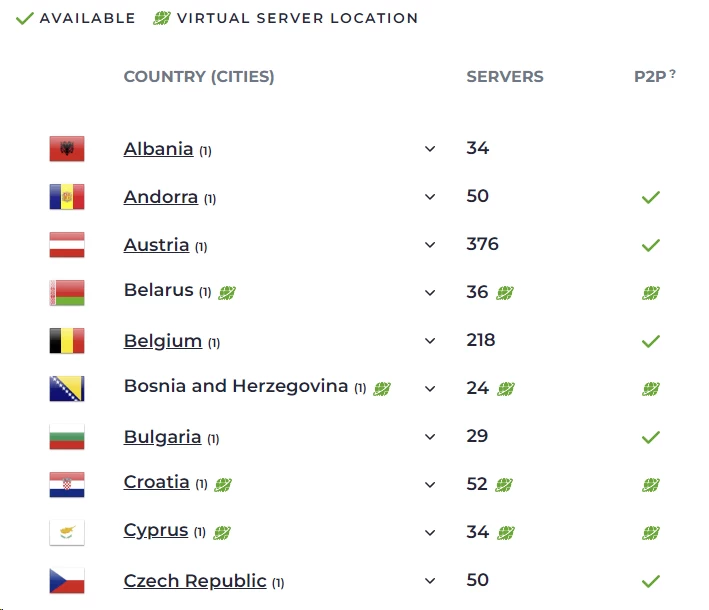
The substantive concern is the virtual versus physical server ratio. CyberGhost operates a mix of servers physically located in their listed countries and virtually located servers – infrastructure physically hosted elsewhere but presenting IP addresses registered to a different jurisdiction. A “Brazilian” server physically located in Miami delivers different latency characteristics, operates under different legal jurisdiction, and routes data differently than a server actually located in São Paulo. CyberGhost’s transparency on which specific country locations are virtual versus physical has room for material improvement. Users connecting to less common country locations for jurisdiction-specific privacy reasons should verify in-country placement rather than assuming the location label reflects physical infrastructure.
Load Distribution: The Performance Benefit That Gets Underappreciated
High server count delivers one concrete performance benefit that marketing positioning undersells: load distribution. A 11,700-server network serving the same subscriber base as a 3,000-server network carries substantially less traffic per server, which directly affects congestion during peak usage hours. The ~89% speed retention on US local servers in testing is partly attributable to connecting to infrastructure with significant capacity headroom. Whether CyberGhost’s network count reflects genuine infrastructure density or virtual-location inflation in specific regions, the concentration of servers in heavily-used Western Europe and US East Coast corridors produces measurable performance benefits for users in those areas.
Why Standard Protocols Fail Against Deep Packet Inspection
CyberGhost does not reliably work in China. The Great Firewall employs deep packet inspection (DPI) that identifies protocol signatures in packet headers and traffic flow patterns – WireGuard, OpenVPN, and IKEv2 all have identifiable characteristics that GFW detection infrastructure flags with increasing accuracy. Consistent VPN functionality inside China requires obfuscation technology that transforms VPN traffic to appear as standard HTTPS traffic at the packet inspection layer, making it statistically indistinguishable from ordinary web browsing. CyberGhost does not implement this.
The Providers That Actually Work in Restrictive Jurisdictions
Providers that maintain functional China access – Astrill (StealthVPN protocol), ExpressVPN (Lightway with active obfuscation), Mullvad (in specific bridge configurations) – invest continuous engineering resources in obfuscation layers that must evolve against GFW’s improving detection capabilities. This is an ongoing technical arms race against state-resourced adversaries. CyberGhost has not entered that race, which is a legitimate product focus decision – but it needs to be stated plainly for anyone evaluating the service for use in a restrictive jurisdiction.
UAE: Policy-Level Enforcement, Same Practical Outcome
The UAE presents a structurally similar constraint through a different mechanism. UAE telecommunications regulation mandates ISP-level blocking of VPN services used to circumvent content restrictions. Enforcement is policy-driven at the carrier level rather than packet-inspection-based, but the practical outcome for standard unobfuscated VPN protocols is equivalent: traffic signatures are identifiable and blockable. CyberGhost users in the UAE report inconsistent connectivity, which is an insufficient reliability standard for a security tool – failure means unprotected traffic exposure, not a buffering indicator.
CyberGhost is engineered for surveillance reduction and content access on open internet infrastructure. It is not a censorship circumvention tool. Iran, Russia, China, and the UAE are outside its operational design envelope. If those jurisdictions are part of your use case, the correct providers to evaluate are those with actively maintained obfuscation protocols – not services that function in standard network environments and may work intermittently in hostile ones.
Streaming & Unblocking

How Streaming-Optimized Servers Work
Labeled Server Architecture: The Logic Behind the Design
CyberGhost’s streaming server organization is among the more operationally coherent implementations in the market. Rather than presenting a generic city-based server list and implying that any server in a given country will unblock that country’s services, CyberGhost maintains servers explicitly labeled by target platform – you don’t connect to “US – New York #847” and run a trial-and-error process; you select a server labeled “Netflix US” specifically. For non-technical users, the cognitive load reduction is real and meaningful.
The infrastructure rationale is sound. Streaming services – particularly Netflix, Disney+, and BBC iPlayer – maintain dynamically updated blocklists of known VPN IP address ranges, using IP reputation scoring, ASN ownership analysis, and connection pattern detection. A dedicated streaming server is one where CyberGhost’s operations team actively monitors IP reputation, rotates addresses when they’re flagged by platform detection systems, and maintains server configurations for streaming traffic specifically rather than general-purpose use. General-purpose servers in the same city may share IP ranges that have already been blocklisted by streaming platforms, while dedicated streaming servers cycle through cleaner residential or commercial IP pools.
Unblocking Results – What Actually Works
CyberGhost’s unblocking record is strong across major English-language platforms:
- Netflix US – confirmed working, including US-specific catalog with 4K throughput where connection supports it
- Netflix UK – confirmed working via UK-labeled streaming servers
- BBC iPlayer – confirmed working; one of the more technically demanding targets given the iPlayer team’s active VPN detection posture
- Disney+ – confirmed working on US servers
- Amazon Prime Video – confirmed working, including US catalog access from outside the region
- Hulu – confirmed working via US streaming-specific servers
- HBO Max (Max) – confirmed working on US servers
- Channel 4 (UK) – confirmed working
- ESPN+ – confirmed working
That list covers the platforms representing the majority of streaming VPN use cases for English-language content consumers. For a subscriber whose core motivation is accessing US and UK libraries from abroad – or maintaining access to home content while traveling – CyberGhost’s streaming infrastructure delivers on its stated capability with reasonable consistency.
Speed, Quality Thresholds, and Confirmed Gaps
Streaming quality holds at local and regional server speeds above 100 Mbps. 4K streaming requires approximately 25 Mbps sustained throughput; CyberGhost’s US local server performance of 347 Mbps provides 13x headroom above that threshold. Buffering on local streaming servers was not a reported issue in testing. The 89 Mbps result on the Australia server clears the 4K threshold in ideal conditions, but optimal-conditions bandwidth figures don’t reflect real-world performance under varying server load – sustained 4K on that connection would be unreliable.
Gaps in the confirmed list deserve equal weight. Netflix regional catalogs beyond US and UK – Japanese, Korean, German – are not confirmed as consistently accessible in testing data. Streaming investment concentrates on the highest-demand markets, and assuming coverage extends to long-tail regional catalogs based on server count would be an error. Sports streaming platforms with aggressive geo-restriction enforcement fall outside the confirmed working list.
Customer Support

24/7 Support Reality Check
Live Chat Performance: Above Average With a Chatbot Obstacle
CyberGhost offers 24/7 live chat support, and the operational reality outperforms the VPN industry average – which is a low bar, but a real one. Initial contact routes through a chatbot triage layer that attempts to resolve common queries through documentation links before escalating to a human agent. For standard queries – billing questions, password resets, connection troubleshooting on common platforms – the automated flow resolves adequately without human intervention. For anything technically nuanced – protocol-specific issues, server-category failures, device registration conflicts – the fastest path through the bot is explicitly requesting a human agent rather than engaging with the automated workflow.
Response Times and Agent Technical Competency
Human agent response times in live chat testing averaged under two minutes during standard hours – faster than most competitors in the same price tier and meaningfully faster than the industry norm of extended holds that encourage abandonment. Agent quality varies, as it does across every large support operation, but technical queries involving protocol configuration, server-specific failures, and device registration management were handled with demonstrated product knowledge rather than copy-pasted documentation responses in the majority of reported interactions. Front-line support demonstrates familiarity with the actual technical architecture – specifically the distinction between registered devices and active sessions, and the steps for resolving device slot conflicts – which is not standard across the VPN support landscape.
Email, Knowledge Base, and the Community Forum Gap
Email support operates on an hours-based response timeline – acceptable for non-urgent configuration questions, inadequate for travel scenarios requiring real-time connection resolution. The knowledge base is extensive and navigable, covering platform-specific setup guides and troubleshooting decision trees for common failure modes. Self-sufficient users resolve the majority of standard issues without reaching support.
The structural gap in CyberGhost’s support offering is the absence of a community forum. There is no user-maintained infrastructure where edge cases, platform-specific quirks, and workarounds for known issues accumulate over time into a searchable knowledge resource. That institutional knowledge currently lives nowhere publicly accessible – which means recurring niche issues get re-diagnosed from scratch by individual support agents rather than being resolved by existing community documentation.
Frequently Asked Questions
Does CyberGhost keep logs of my web traffic?
No. CyberGhost operates under a no-logs policy that has been audited by Deloitte and runs its server infrastructure on volatile RAM, so data is wiped whenever a machine is rebooted. The service does collect limited, aggregated connection metadata, but not information that would directly link your identity to specific browsing activity.
Can I use CyberGhost to torrent safely?
Yes, CyberGhost supports P2P traffic on dedicated servers and masks your IP address from third parties. However, based on our tests, download speeds on some locations are noticeably lower than the baseline, and the lack of port forwarding can negatively affect seeding performance.
Does the ad-blocker actually work on YouTube?
Not in the way most users expect. The built-in “Block Content” feature works as a DNS-based filter that can block known tracking and some ad-serving domains, but it cannot remove video ads on platforms like YouTube or Twitch. For comprehensive ad and tracker blocking in the browser, you still need a dedicated extension such as uBlock Origin.
Does CyberGhost offer port forwarding?
No. CyberGhost does not provide port forwarding on any of its servers, citing potential security risks as the reason. If you rely on port forwarding for optimizing torrent swarms or hosting game servers, you will need to consider a provider that explicitly supports this feature.
Can I install CyberGhost on my router?
Yes, CyberGhost can be configured on compatible routers using manual VPN setup. The service does not offer its own custom router firmware, so you will need to use OpenVPN configuration files and, in some cases, third-party firmware such as DD-WRT or Tomato, which requires a bit more technical effort.
Are the virtual servers a security risk?
Virtual servers do not weaken encryption; your traffic remains protected regardless of where the hardware is physically located. However, when a server is advertised as being in one country but hosted elsewhere, this can affect latency and may place the infrastructure under a different legal jurisdiction than the label implies.
Is CyberGhost Good for Netflix?
Yes. CyberGhost reliably unblocks Netflix US and Netflix UK through servers that are specifically labeled and optimized for these platforms, and the provider actively rotates IPs to stay ahead of VPN blocklists.
Is the dedicated IP address truly private?
CyberGhost’s dedicated IP implementation is designed to minimize the link between the IP and your account. Instead of tying the address directly to your profile, the service issues a cryptographic token at purchase, which you later redeem in the app, so the IP cannot be straightforwardly correlated with your billing identity.

