

PrivadoVPN 2026 review: Deep Technical Analysis of the Swiss VPNPrivado
- Offers an unparalleled 10GB/month free tier on bare-metal infrastructure, hard-throttled to 1 Mbps upon depletion to prevent botnet abuse.
- Headquartered in Zug, Switzerland, legally shielding user data from the 5/9/14 Eyes intelligence alliances under the robust Federal Act on Data Protection (FADP).
- Implements reliable AES-256-GCM and ChaCha20 cryptographic ciphers via OpenVPN and WireGuard, but critically lacks independent third-party privacy audits.
- Pricing strategy aggressively funnels users toward a heavily discounted 24-month contract ($1.11/mo), with mathematically inefficient premium pricing for monthly rolling terms.
- Effectively bypasses CDN geo-restrictions for major streaming platforms (Netflix US/UK, BBC iPlayer) but lacks port forwarding required for efficient P2P swarm seeding.
- Network topography is highly asymmetric, concentrating physical nodes in North America and Europe while severely underserving Africa, South America, and the Middle East.
| 💰 Pricing | From $1.11 to $10.99/mo (paid plans) |
| ✅ Free Trial | 10GB Free Plan (no time limit, 10GB every 30 days) |
| 📆 Money Back Guarantee | 30 Days |
| 🗺 Jurisdiction | Switzerland |
| 🖥 Number of Servers | 500+ servers in 50 countries |
| 📝 Logging Policy | No‑logs |
| 📥 Torrenting/P2P | Yes, P2P and SOCKS5 supported on many servers |
| 🍿 Streaming | Supports major platforms on Premium (e.g. Netflix, Hulu, BBC iPlayer) |
| 🛡 Kill Switch | ✅ Desktop and mobile apps include Kill Switch |
| ⚙️ Protocols | OpenVPN (UDP/TCP/Scramble/DCO), WireGuard, IKEv2 |
| 🛠 Support | 24/7 Support (tickets/email, live help for Premium) |
| 💻 Simultaneous Devices | Up to 10 devices on Premium (1 connection on Free) |
| 🔥 Current Deal | 87% OFF (on 2-year plan) |
Overview
Architectural philosophy and market positioning
Founded in 2019 by Privado Networks AG and headquartered in Zug, Switzerland, PrivadoVPN entered a saturated consumer VPN market with a clearly defined architectural bet: physical-only, bare-metal infrastructure at every node. Most competitors scale quickly by leasing virtual private servers (VPS) from third-party cloud providers, which allows them to advertise IP addresses in one country while the actual hardware sits in a data center halfway across the world. A VPN listing an Egyptian server that physically resides in Frankfurt is a virtual location. PrivadoVPN rejects this practice entirely.
Technical breakdown
The provider operates a proprietary network of approximately 500+ physical servers across 50 countries. By owning the hardware stack directly, PrivadoVPN eliminates several classes of risk common to VPS-dependent architectures:
- Virtualization overhead: Hypervisor-mediated I/O on shared VPS instances adds unpredictable latency at the network layer; bare-metal removes this variable entirely.
- Third-party hypervisor exposure: Shared VPS environments create a multi-tenant attack surface; any hypervisor-level vulnerability (e.g., VM escape exploits) potentially exposes co-tenants.
- Deceptive geolocation: Virtual locations manipulate IP WHOIS records to misrepresent physical routing paths, inflating server counts without adding genuine global coverage.
Why it matters in practice
The tradeoff is real. PrivadoVPN’s physical-only network is dramatically smaller than providers like NordVPN or ExpressVPN, which deploy 5,000+ nodes by leasing VPS capacity. The result is conspicuous geographic gaps. Africa is reduced to a single node in Johannesburg. The Middle East has one server, in Israel. Users routing traffic through these underrepresented regions face multi-hop packet journeys averaging 180–250ms in additional latency compared to what a nearby virtual server would provide.
From a market positioning standpoint, PrivadoVPN targets the casual streaming consumer while simultaneously leveraging Swiss jurisdiction for privacy branding. These goals are in structural tension. High-throughput streaming nodes require aggressive IP pool cycling to evade CDN blacklists. A genuine zero-knowledge network minimizes the operational data it even stores. Reconciling these two objectives defines most of the engineering compromises visible throughout the product.
The mechanics of the freemium tier
PrivadoVPN’s free tier allocates 10GB of data per 30-day cycle. That figure is mechanically significant when benchmarked against the primary Swiss competitor. ProtonVPN offers unlimited bandwidth on its free tier but enforces hard network-level restrictions: users cannot select specific server nodes, and P2P (BitTorrent) packets are dropped at the network edge entirely.
Technical breakdown
PrivadoVPN takes the opposite approach. The 10GB allowance runs on the same physical infrastructure as paid accounts, with no protocol throttling or traffic shaping applied below the cap. Free users can manually select ingress nodes from 13 distinct geographic locations, including routing points in the US, UK, Brazil, and Germany. Critically, the provider does not block UDP or TCP P2P traffic on these free nodes, making the service a viable, if short-lived, tool for secure file transfers.
When usage crosses the 10.01GB threshold, the service enters “Lite Mode.” Rather than terminating the session, PrivadoVPN applies aggressive traffic shaping at the network edge, imposing a hard 1 Mbps ceiling. At 1 Mbps:
- 4K UHD streaming (requires 15–25 Mbps) becomes impossible.
- 1080p streaming (requires 5 Mbps) buffers continuously.
- Large BitTorrent swarms stall due to insufficient upstream bandwidth.
- DNS resolution, SSH sessions, basic TLS handshakes, and plain-text HTML rendering remain functional.
Failure scenarios
The free tier has a deliberate friction mechanism embedded in its UX: users must manually re-authenticate and renew their data allowance every 30 days through the web portal. Missing this renewal locks the account into permanent Lite Mode until the manual reset is completed. This is not an accident. The 30-day manual renewal cycle is an explicit design decision to prune dormant accounts and prevent automated botnet abuse of the free infrastructure. If you forget the renewal cycle, you will not receive a notification, and your connection will silently throttle to 1 Mbps.
Pricing & Plans
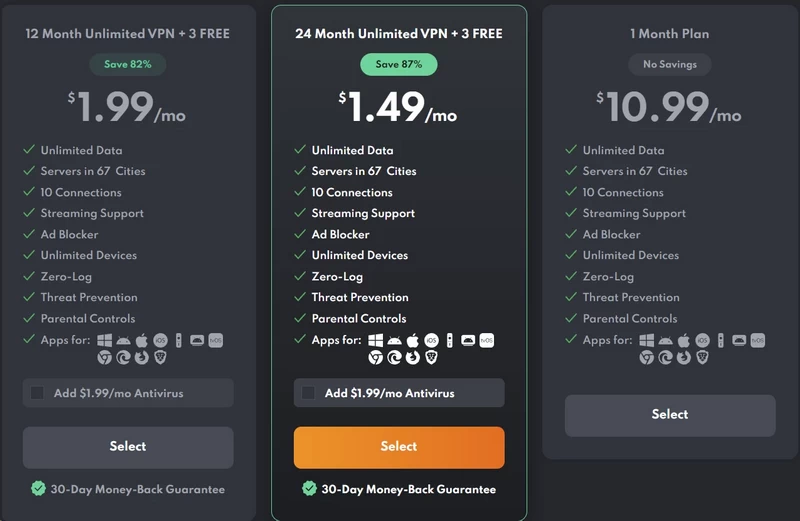
2026 pricing matrix and ROI analysis
PrivadoVPN’s pricing architecture follows a well-established SaaS retention pattern: an inflated monthly rate functions as a deterrent, funneling users into deeply discounted multi-year commitments that lock in revenue while reducing churn.
| Plan Tier | Billing Frequency | Total Upfront Cost | Effective Monthly Rate | Discount vs. Monthly |
|---|---|---|---|---|
| Free Tier | 30-Day Manual Renewal | $0.00 | $0.00 | N/A |
| 1-Month Plan | Monthly | $10.99 | $10.99 | 0% |
| 12-Month Plan | Annually (+3 Free Months) | $20.00 | $1.33 | 88% |
| 24-Month Plan | Biennially (+3 Free Months) | $30.00 | $1.11 | 90% |
Promotional pricing fluctuates. The matrix above reflects 2026 acquisition rates prior to renewal increases.
Why it matters in practice
At $10.99 per month, the rolling contract sits squarely in the premium pricing bracket. For any requirement beyond a short-term evaluation or single-trip use case, this rate is economically indefensible when the 24-month option exists. The 24-month plan drives the effective rate to $1.11 per month ($30 upfront for 27 months of service), operating as a loss-leader acquisition strategy.
Failure scenarios
You must calculate the total cost of ownership beyond the promotional window. These introductory rates expire. Upon renewal, the 12-month plan typically resets to approximately $60.00 annually ($5.00 per month), and the 24-month plan to approximately $96.00 ($4.00 per month). The ROI collapses significantly at renewal. Set a calendar reminder before your initial term ends. Renewal billing is automated; you will not receive a prominent warning.
Add-ons, payment gateways, and anonymity

Technical breakdown
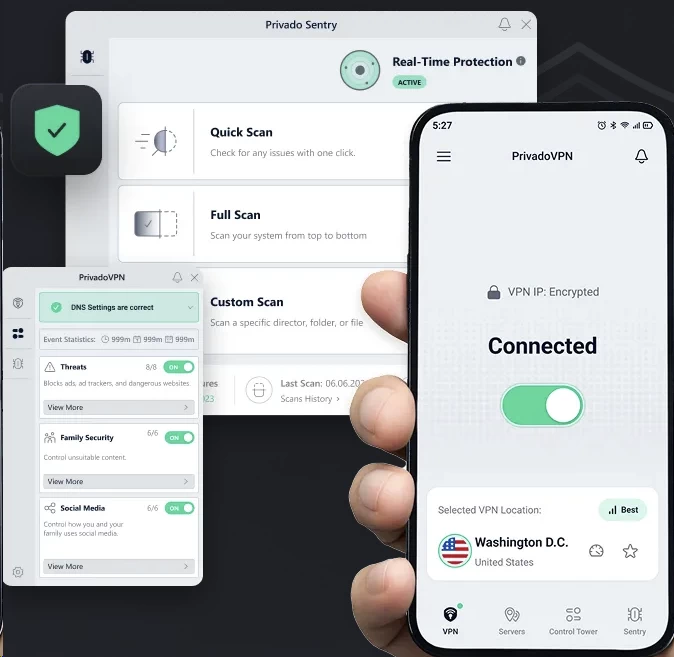
PrivadoVPN expands average revenue per user through modular add-ons, primarily “Privado Sentry,” priced at an additional $1.99 per month. Sentry is a locally installed antivirus client, currently available for Windows and Android. Mechanically, it runs:
- Background heuristic and signature-based malware scanning
- Active file quarantine on detection
- Real-time execution monitoring for suspicious process behavior
From a cybersecurity standpoint, deploying Sentry alongside a dedicated Endpoint Detection and Response (EDR) solution such as CrowdStrike Falcon or Microsoft Defender for Endpoint is redundant. EDR solutions provide behavioral telemetry, kernel-level visibility, and threat intelligence integration that a bundled VPN antivirus cannot replicate. For technically proficient users, PrivadoVPN’s network-level DNS filtering (Control Tower, discussed below) is the more efficient security layer. Sentry is an upsell targeted at less technically experienced subscribers.
Real-world use case
Regarding payment anonymity: PrivadoVPN accepts Credit/Debit Cards, PayPal, and SEPA transfers. All fiat payment gateways generate a KYC-compliant financial paper trail that permanently links your real-world identity to your VPN account.
The provider also accepts Bitcoin (BTC), Ethereum (ETH), Litecoin (LTC), and Monero (XMR). Bitcoin’s transparent blockchain is vulnerable to chain analysis tools like Chainalysis. If privacy is the objective, Monero is the only mathematically sound option: its ring signature protocol and stealth address system obfuscate the sender, receiver, and transaction amount simultaneously.
All paid tiers include a 30-day money-back guarantee. Refunds on fiat transactions are straightforward. Refunds on cryptocurrency payments are subject to network transaction fees and exchange rate volatility between the time of purchase and refund processing. The fiat-equivalent value returned may differ materially from the original outlay.
Features & Client Ecosystem
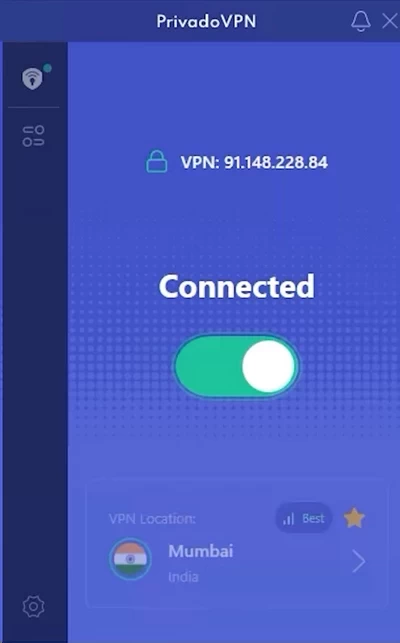
Cross-platform client analysis
PrivadoVPN deploys native applications across Windows, macOS, iOS, and Android. The subscription supports 10 simultaneous connections, which comfortably covers most multi-device households without triggering session limits.
Technical breakdown
Cross-platform parity is inconsistent. The Windows and Android clients are the most mature builds, offering integrated split tunneling and app-level kill switch controls. The ecosystem degrades on other platforms:
- Linux: No native GUI client exists. Linux administrators must configure OpenVPN manually through NetworkManager or raw CLI tooling. Competing providers including Mullvad, ProtonVPN, and NordVPN offer full-featured Linux CLI clients with integrated WireGuard and kill switch logic. For Linux users, PrivadoVPN is a significant step backward.
- Browser extensions: No standalone, fully featured browser extensions are available. Users cannot selectively proxy only browser traffic while leaving other system traffic on the ISP connection. The architecture forces an all-or-nothing choice: route the entire host machine’s network stack through the VPN, or route nothing at all.
- macOS: Split tunneling is technically available but requires navigating Apple’s strict network extension permission model, which adds several administrative steps that competing providers have already streamlined.
Failure scenarios
The absence of a Linux GUI is not a minor inconvenience for Linux server administrators using PrivadoVPN for remote management tunnels. Manual OpenVPN configuration through NetworkManager lacks integrated kill switch enforcement at the CLI level. If the VPN tunnel drops during an SSH session, the connection will fall back to the unprotected ISP interface unless the administrator has manually written iptables rules to blackhole non-tunnel traffic.
Kill switch mechanics and design flaws
A kill switch monitors VPN tunnel state and drops all outbound network traffic the moment the encrypted connection fails, preventing unencrypted packet leakage that would expose the real IP address to the destination server.
Technical breakdown
PrivadoVPN implements two kill switch modes:
- App-level kill switch: Monitors specific Process IDs and drops traffic only from designated applications if the tunnel fails. Other system processes continue routing normally.
- System-level kill switch: Modifies the host OS routing table directly, using Windows Filtering Platform (WFP) on Windows or iptables on Linux to drop all outbound packets not routed through the VPN interface.
Stress testing under forced disconnect scenarios confirms that the packet-dropping logic functions correctly and prevents IP leaks. However, the system-wide kill switch has a significant design flaw.
Failure scenarios
If you intentionally disconnect from a server or cleanly shut down the PrivadoVPN application while the system-level kill switch is active, the WFP or iptables firewall rules persist. Your machine’s internet access is completely blackholed until you manually toggle the kill switch off from inside the UI before exiting. A properly engineered kill switch must distinguish between an unexpected tunnel collapse (which should trigger the blackhole) and a deliberate, user-initiated daemon termination (which should cleanly restore the default routing table). PrivadoVPN does not make this distinction. If you close the app and walk away, you will return to a machine with no internet access.
SmartRoute split tunneling implementation
PrivadoVPN’s split tunneling, branded as “SmartRoute,” allows specific application traffic to bypass the VPN tunnel’s TUN/TAP virtual interface and route directly through the default ISP gateway. This is useful for banking apps that block known VPN IP ranges, or for latency-sensitive games you want to run on the native connection while keeping a browser session tunneled.
Technical breakdown
SmartRoute operates on an exclusion model only. You select which applications bypass the VPN. You cannot configure it in the opposite direction, specifying that only certain applications use the VPN while everything else routes normally. This distinction matters in practice: if you want to tunnel only your torrent client while every other application uses the ISP connection, SmartRoute cannot do this. You would need to invert the logic by adding every application except your torrent client to the exclusion list, which is impractical on a typical workstation with dozens of background processes.
Real-world use case
On Windows and Android, SmartRoute functions reliably. On macOS, enabling it requires granting deep system-level network extension permissions, a process that Apple’s security model intentionally makes cumbersome. Users on corporate macOS devices with restricted MDM profiles may be unable to enable SmartRoute at all, as the required network extension entitlements may be blocked by the MDM policy.
DNS filtering: Control Tower
“Control Tower” is PrivadoVPN’s proprietary DNS sinkholing feature. It intercepts DNS queries at the network level. When a client requests the IP address of a blacklisted domain, the resolver returns a null route (0.0.0.0), preventing the TCP connection from ever initializing.
Technical breakdown
Control Tower offers categorical filtering toggles, including Social Media restrictions and Family Security (covering gambling and adult content domains). As a parental content filter or productivity tool, the categorical blocking works adequately for well-known domains in its database.
As a cybersecurity defense, the numbers are damaging. When tested against live threat intelligence feeds from sources including abuse.ch and PhishTank:
- Control Tower blocked only 2% of active malware distribution domains.
- It blocked only 6% of live phishing links.
These figures indicate the threat definition database is either severely outdated or draws from an incomplete, commercially aggregated block list rather than real-time threat intelligence. Control Tower cannot be used as a substitute for a dedicated EDR or anti-malware solution. It is a basic content filter, not a threat prevention platform.
SOCKS5 proxy integration
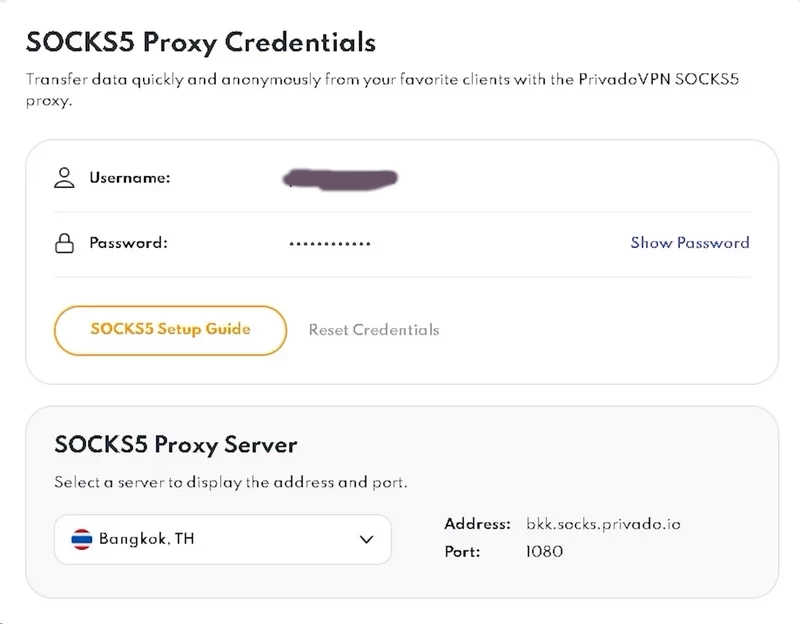
Technical breakdown
PrivadoVPN’s paid tiers include access to a SOCKS5 proxy infrastructure. It routes packets between client and destination through a proxy server, masking the public IPv4 and IPv6 addresses from the endpoint.
The critical distinction: SOCKS5 does not apply AES-256 encryption. For P2P workloads, this is a deliberate engineering tradeoff, not a flaw. Encrypting and decrypting thousands of simultaneous TCP/UDP connections in a dense BitTorrent swarm generates significant cryptographic overhead, consuming CPU cycles and limiting I/O throughput. By configuring PrivadoVPN’s SOCKS5 proxy credentials directly inside a torrent client (qBittorrent or Transmission both support per-client proxy configuration), you route swarm traffic through the proxy for IP masking while eliminating the encryption bottleneck entirely.
Real-world use case
A user downloading a 50GB Linux ISO in a dense swarm on a local VPN connection at 806 Mbps will hit approximately 1.5 hours to completion. The same download routed through the SOCKS5 proxy, eliminating encryption overhead on a 950 Mbps baseline fiber connection, will complete in roughly 1.1–1.2 hours. The tradeoff is that the payload itself transmits in plain text. Any observer on the network path can inspect packet contents. Use the SOCKS5 proxy only when IP masking is the requirement and payload encryption is not.
Speed & Performance
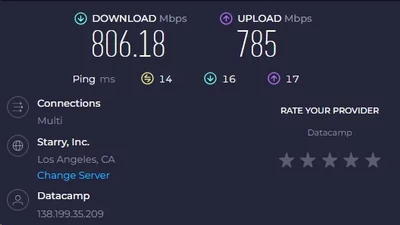
Benchmark results
Benchmarks were conducted on a 1 Gbps symmetric fiber connection. Multiple testing windows were used to account for peak server load variations.
| Test Environment | Ping (ms) | Download (Mbps) | Upload (Mbps) | % Download Loss |
|---|---|---|---|---|
| Baseline (No VPN) | 2 | 950 | 945 | N/A |
| Local Server (Los Angeles) | 14 | 806 | 785 | 15.1% |
| Mid-Range (New York) | 82 | 691 | 540 | 27.2% |
| Distant Server (UK, London) | 212 | 183 | 126 | 80.6% |
| Distant Server (Tokyo) | 240 | 165 | 105 | 82.6% |
Cryptographic overhead and protocol efficiency
PrivadoVPN supports three tunneling protocols: WireGuard, OpenVPN (TCP and UDP modes), and IKEv2.
Technical breakdown
Under standard network conditions, WireGuard’s lean ~4,000-line codebase, using ChaCha20 for symmetric encryption and Poly1305 for authentication, consistently outperforms OpenVPN’s heavier AES-256-GCM implementation on equivalent hardware. This is a well-documented benchmark outcome across the industry.
PrivadoVPN presents an anomaly. In specific load scenarios, OpenVPN UDP outpaced WireGuard: WireGuard stabilized at approximately 550 Mbps while OpenVPN UDP peaked at 806 Mbps on US East nodes. This behavior points to a backend infrastructure issue, specifically how PrivadoVPN’s load balancers handle WireGuard’s stateless UDP connection model versus OpenVPN’s established session management. WireGuard’s stateless design means each packet is processed independently; a poorly configured load balancer may not maintain session affinity correctly, causing WireGuard packets to bounce between server instances and introducing retransmission overhead. IKEv2 performs as expected: efficient at handling network interface switches (Wi-Fi to cellular) on mobile devices, but limited in raw desktop throughput compared to WireGuard and OpenVPN.
Real-world use case
If you are connecting from a US-based fiber connection to US East servers, use OpenVPN UDP. The current infrastructure appears better optimized for it than for WireGuard. On mobile connections or when switching frequently between Wi-Fi and cellular, use IKEv2 to avoid tunnel renegotiation during handoffs.
Physical server latency impact
Why it matters in practice
Bare-metal physical infrastructure dictates a fixed latency floor determined by geographic distance and the number of intermediate routing hops. Competitors using virtual servers deployed at network edge locations can artificially reduce latency by placing nodes at internet exchange points closer to users, regardless of whether the underlying hardware is nearby.
PrivadoVPN’s physical-only architecture eliminates deceptive geolocation but forces raw cable routing for distant destinations. Transatlantic and transpacific connections exceed 200ms ping, not because the servers are slow, but because fiber-optic cables under the Pacific Ocean have a physical speed-of-light limit. For competitive gaming, a 200ms+ ping to a distant server makes real-time applications unplayable. PrivadoVPN is not a viable gaming VPN for foreign server connections.
Real-world throughput for streaming and P2P
Real-world use case
For 4K UHD streaming, Netflix requires a sustained 15–25 Mbps connection. Even on the worst-performing distant server (133.5 Mbps to Australia), PrivadoVPN retains more than sufficient throughput overhead. Buffering is not caused by bandwidth constraints but by the 200ms ping increasing the time required for the initial TLS handshake and first video segment delivery. On a hotel Wi-Fi connection capped at 20 Mbps baseline, PrivadoVPN’s encryption overhead will consume approximately 10–15% of available bandwidth, leaving 17–18 Mbps for streaming. At that level, 1080p streams remain stable; 4K becomes marginal.
For P2P workloads: BitTorrent swarms generate large volumes of simultaneous TCP and UDP connections. When routing through the VPN tunnel, the cryptographic overhead of encrypting thousands of concurrent connections hits CPU utilization hard on low-end hardware. On a machine with a dual-core processor running at 2.4 GHz, AES-256-GCM encryption at full swarm capacity will peg a single core, creating an I/O bottleneck that limits effective throughput to 150–200 Mbps even when the network connection supports more. The SOCKS5 proxy, which strips encryption entirely, resolves this on hardware-constrained devices.
Security & Privacy
Cryptographic standards and leak prevention
Technical breakdown
On OpenVPN, PrivadoVPN secures the data payload using AES-256-GCM (Galois/Counter Mode). GCM provides authenticated encryption, meaning it simultaneously encrypts the payload and generates a message authentication tag. This prevents padding oracle attacks, which exploit the separation between encryption and authentication in older cipher modes like CBC. The handshake uses RSA-2048 key exchange for initial key negotiation.
On WireGuard, the service uses ChaCha20 for symmetric encryption and Poly1305 for message authentication. ChaCha20 is a stream cipher that outperforms AES-256-GCM on devices without hardware AES acceleration, which includes most ARM-based mobile processors running Android or iOS.
Why it matters in practice
Leak prevention was tested using Wireshark packet capture under forced disconnect scenarios and protocol switching. Results:
- DNS leaks: None detected. All DNS queries route through PrivadoVPN’s encrypted resolvers, preventing ISP-level DNS query logging.
- IPv6 leaks: None detected. The client blocks IPv6 traffic at the adapter level, preventing dual-stack routing anomalies where IPv6 traffic bypasses the VPN tunnel entirely.
- WebRTC leaks: None detected. Browser WebRTC APIs, which normally bypass virtual interfaces to expose the real public IP, are successfully mitigated.
The cryptographic implementation and local leak prevention are sound. This section of the product works as advertised.
Swiss jurisdiction: FADP vs. 14 Eyes
Technical breakdown
PrivadoVPN is operated by Privado Networks AG in Zug, Switzerland. Switzerland is not a signatory to the UKUSA Agreement (5 Eyes) or its extended 9 Eyes and 14 Eyes variants. Swiss law does not require VPN providers to participate in bulk warrantless signal interception programs operated by the NSA, GCHQ, or equivalent foreign signals intelligence agencies.
PrivadoVPN operates under the Swiss Federal Act on Data Protection (FADP). Under FADP, IP addresses are classified as personal data. Swiss law prohibits preemptive, forced data retention by VPN providers. A legally binding subpoena from a Swiss cantonal or federal court, typically requiring documented evidence of severe criminal activity recognized under the Swiss penal code, is required before the company can be compelled to log or surrender user data.
Why it matters in practice
This legal structure is a meaningful operational security advantage for users concerned about mass surveillance or extraterritorial data requests from US or EU law enforcement. It is not an absolute shield. A legitimate Swiss criminal investigation targeting a specific user can still result in data disclosure. If the data was never collected in the first place, there is nothing to disclose, which is where the logging policy and audit deficit become critical.
The audit deficit and logging policy analysis
Technical breakdown
PrivadoVPN’s stated zero-logs policy covers:
- Browsing history
- DNS query logs
- Traffic destination records
- Origin IP addresses
However, a detailed reading of the privacy policy identifies data that is collected and retained:
- Email addresses
- Payment data
- Aggregate bandwidth usage (required for 10GB cap enforcement on the free tier)
- Anonymized app version and OS telemetry
Failure scenarios
The most significant structural weakness in PrivadoVPN’s security posture is the complete absence of an independent third-party infrastructure audit. In 2026, established VPN providers routinely commission security firms, including PwC, Deloitte, and Cure53, to audit their codebases, server configurations, and logging systems. PrivadoVPN has not undergone this scrutiny. No audit report exists.
Compounding this: PrivadoVPN has not transitioned to diskless, RAM-only server architecture. Competitors including Mullvad and ExpressVPN (after its Lightway-era infrastructure rebuild) operate servers that store nothing on persistent hard drives. All operational data is held in volatile RAM and is permanently wiped on any power cycle. If a PrivadoVPN server running traditional HDD or SSD storage is seized by authorities or compromised physically, forensic recovery of residual filesystem data is technically feasible using tools like Autopsy or FTK even after standard file deletion. RAM-only infrastructure closes this attack vector entirely. Until PrivadoVPN implements RAM-only servers and commissions an independent audit, its privacy claims rest on unverified marketing copy. In 2026, that is not an acceptable foundation for a product whose core value proposition is trust.
Server Network Infrastructure

Bare-metal network topography
Technical breakdown
PrivadoVPN operates approximately 500+ physical servers across 50 countries and roughly 66 cities. The network topology is heavily asymmetric. Deployment is dense in the United States (14 distinct city-level nodes) and Western Europe. Outside these regions, coverage collapses:
- South America: Two locations, Brazil and Argentina.
- Africa: One node, in Johannesburg, South Africa.
- Middle East: One server, in Israel.
- Southeast Asia: Sparse coverage with no presence in major routing hubs like Vietnam, Thailand, or the Philippines.
Why it matters in practice
For a user in Lagos attempting to access a regional African streaming platform through a nearby server, PrivadoVPN has nothing to offer except a 150ms+ transoceanic route to Johannesburg. The physical-only infrastructure commitment prevents the provider from rapidly adding virtual nodes to underserved markets. While the bare-metal approach guarantees the user is actually connecting to hardware in the advertised jurisdiction, it imposes a hard ceiling on global utility that disproportionately affects users outside North America and Western Europe.
Real-world use case
A user in Dubai connecting to PrivadoVPN’s single Middle Eastern server in Israel will experience routing paths that transit multiple regional internet exchange points before reaching the destination, typically adding 60–90ms of latency beyond what a geographically local server would provide. For standard browsing and streaming, this is acceptable. For VoIP calls or real-time collaborative applications where jitter above 50ms degrades voice quality perceptibly, this infrastructure gap is a functional limitation.
Streaming, P2P & Censorship
Streaming unblocking efficacy
CDN operators like Akamai and Fastly maintain dynamically updated IP reputation databases. These systems run automated detection algorithms that flag IP ranges associated with known VPN exit nodes, triggering geo-block enforcement. Defeating these blocks requires a VPN to maintain large, frequently rotated IP pools that stay ahead of the blacklist update cycles.
Why it matters in practice
PrivadoVPN reliably unblocks:
- US Netflix
- UK Netflix
- Amazon Prime Video (US)
- Disney+ (US)
- BBC iPlayer (UK)
Consistently accessing these primary libraries, including on the free tier until the data cap is reached, requires maintaining IP ranges that evade Netflix’s DPI-enhanced VPN detection system, which cross-references subnet ownership, datacenter ASN registration, and connection timing heuristics.

Failure scenarios
Efficacy degrades on secondary regional catalogs. Netflix Canada geo-restrictions are not reliably bypassed. Hulu, which uses aggressive domestic IP range blacklisting combined with ASN-level blocking of known datacenter subnets, regularly identifies and blocks PrivadoVPN exit nodes. Users with niche regional streaming requirements (DAZN, Crunchyroll regional variants, Canal+) should verify compatibility before committing to a subscription. PrivadoVPN lacks the IP rotation scale of providers like NordVPN or Surfshark, which maintain larger pools specifically to stay ahead of Hulu and similar aggressive blockers.
P2P routing and the lack of port forwarding
Technical breakdown
PrivadoVPN permits BitTorrent traffic across its entire server network without restricting users to dedicated “torrenting servers.” This prevents regional node bottlenecking and allows selection of the lowest-latency available exit point.
The critical limitation for dedicated P2P users: PrivadoVPN does not support port forwarding. In BitTorrent’s DHT and tracker-based peer discovery, port forwarding allows inbound connections from swarm peers to traverse the VPN’s NAT firewall. Without it, you operate in a “connectable” state only for outbound-initiated peers. You cannot accept inbound connections. On a sparsely populated swarm where most peers are also behind NAT without port forwarding, this results in a severely degraded peer discovery rate, lower download speeds, and an inability to seed effectively. For users on private trackers with enforced upload ratio requirements, the absence of port forwarding is a functional disqualifier.
Obfuscation (Scramble) and deep packet inspection
Technical breakdown
PrivadoVPN includes an obfuscation feature called “Scramble,” available exclusively on the OpenVPN protocol. Mechanically, Scramble applies an XOR patch to OpenVPN packet headers. The XOR transformation masks the byte-pattern signatures that DPI firewalls use to identify OpenVPN handshakes, making the traffic resemble randomized HTTPS traffic on port 443.
Failure scenarios
Scramble is effective against passive DPI filtering deployed on corporate and university networks, which typically run commercial off-the-shelf firewall appliances (Palo Alto, Fortinet) using signature-based protocol identification. Against these systems, XOR obfuscation breaks the signature match and the connection is allowed.
Against the Great Firewall of China (GFW), Scramble consistently fails. The GFW does not rely solely on passive signature matching. It uses active probing, sending protocol-specific probe packets to suspected VPN endpoints to test their response behavior, and heuristic timing analysis to detect statistically anomalous connection patterns. XOR obfuscation on OpenVPN does not defeat active probing. Users operating in China, Iran, Russia, or other high-censorship environments requiring persistent, reliable access need bespoke obfuscation protocols. Shadowsocks, V2Ray with WebSocket transport, or proprietary stealth protocols (as deployed by Astrill VPN or VyprVPN’s Chameleon) are the technically appropriate tools for these environments. PrivadoVPN is not.
Customer Support & Documentation
Ticketing system vs. live chat
Why it matters in practice
PrivadoVPN advertises 24/7 customer support with live chat. In practice, the live chat interface frequently functions as an asynchronous frontend for the email ticketing system. Real-time access to a Tier 1 or Tier 2 support engineer through chat is available only during certain hours and is inconsistent outside business hours in Central European time.
When the ticket system is the only available channel, response times range from a few hours to a full 24-hour cycle. Response quality is generally technically accurate but follows tiered diagnostic scripts. For infrastructure-level queries, the initial response often requests basic diagnostic data (OS version, exact protocol in use) that is irrelevant to the underlying issue before escalating to a knowledgeable technician. This adds one to two additional response cycles before substantive troubleshooting begins.
Failure scenarios
PrivadoVPN’s self-service Knowledge Base is adequate for consumer-level setup tasks. It covers:
- Basic installation walkthroughs with screenshots across all supported platforms
- Router configuration guides for pfSense and DD-WRT
- SOCKS5 proxy setup for third-party applications
However, the Knowledge Base is effectively empty for advanced troubleshooting. There is no documentation covering:
- Subnet conflict resolution when the VPN’s 10.x.x.x address space collides with a local network
- TAP vs. TUN adapter selection and failure states on Windows
- Advanced routing table override procedures for split-tunnel edge cases
- OpenVPN log interpretation for handshake failures
Power users encountering these issues are left to diagnose their own network stack failures using external resources. PrivadoVPN’s documentation is built for the consumer who installs the app, clicks connect, and never looks at a log file.

